Showing posts with label Cosmos - Fox. Show all posts

Tuesday, June 10, 2014

The Earth Is Where We Make Our Stand - Cosmos - Season 1, Episode 13

How big a universe do you want to live in?  How much do you want to know about the universe?  How many questions are you, as a person, and we, as a society, willing to ask?  And how many answers are we willing to search for?

Tyson doesn't actually answer these questions.  His mission, this entire season, has been to show that answers are out there, for anyone willing to put in the time, and the thought to answering them.  Tyson takes us through one last look at science's history, before ending the season (but hopefully not the series!) by repeating his five basic rules for determining what is true, and telling us to go find our own mysteries to solve.

Tyson asks us to think about a distant star.  With a few planets orbiting.  Now, imagine that one of these planets contained a species capable of abstract thinking.  But, that species thought that they were the center of a universe made specifically for them.  And that a book written in the dawn of their species' writing contained all the answers about the universe.  How seriously would we take this species?  And would we recognize ourselves, only a few centuries ago, in this species?  Tyson points out that, up until a few centuries ago, Europeans didn't even think North or South America existed.  And the Americas' indigenous peoples didn't even wonder if Europe existed.  How could humanity be so ignorant, up until so recently in our species' history?

We start in Alexandria, which supported the most impressive library between about 200 BCE and 391 CE.  The Library at Alexandria was a vast academic resource, famous for raiding ships and other lands for... books.  Which would be copied, and the copies stored in Alexandria.  Supported by the royal family, the Ptolemaic Dynasty of Egypt, the Library at Alexandria supported ancient academics for centuries.
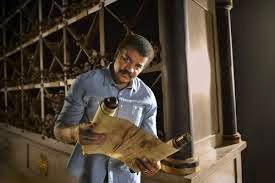
Library fines were in ears of corn

Notable faculty included:  Euclid, enemy of 10th grade geometry students everywhere; Archimedes, all-around best scientist and engineer: Eratosthenes, who first calculated the circumference of the Earth and the tilt of the Earth's axis; the mathematicians Theon and his daughter, Hypatia; and Aristarchus, who proposed that the Sun was at the center of the known universe, with the Earth orbiting it.

So what happened?  Well, we know it was destroyed, in various phases, from multiple wars and conquests, starting in about 48 BCE by Julius Caesar invading.  In about 270 CE, Emperor Aurelian invaded, destroying more and taking some scrolls for himself in Constantinople.  Emperor Theodosius, in 390 CE, may have ordered what little remained destroyed when Christianity became the only legal religion of Rome.  And, ibn al Aas may have finished the job in about 642 CE.  Different parties blame each other, making it extremely difficult to know who did what.  What we do know, is that vast troves of ancient knowledge were lost, and Europe entered the Dark Ages.  Tyson's point is that knowledge can only be preserved if we make an effort to preserve it.

So, what happens when knowledge is preserved for future generations?  Tyson then takes for a hot air balloon ride.  With a man named Victor Hess, in 1912.  At the time, radioactive energy had been discovered, usually emanating from sources such as uranium.  Since these were all rocks on Earth, the theory at the time was that radioactive energy came from the Earth.  So, Hess tested that theory by measuring levels of radioactive energy at different levels in the atmosphere, in a hot air balloon.  


Also discovered the Fifth Dimension singing that balloon song

If radiation was coming from the Earth, the radiation levels would decrease with height.  And they did, until about half a mile up.  After that, the radiation levels rose dramatically, the opposite of what was expected. And Hess measured as far up as about 3 miles, which is about half the elevation of a cruising jet plane. Was radiation coming from our Sun?  It seemed a likely culprit, so Hess conducted his radiation measurements, still in a balloon, during a solar eclipse.  And at night.  Still, a constant stream of radiation.  Earth was awash in cosmic radiation all the time.  But where did it come from?

Stars blowing up.  In the 1930s, Fritz Zwicky, working with his partner, Walter Baade, spent years finding supernova explosions, which is where a star with no fuel reserves has finally collapsed under its weight, and the resulting bounce back out is a giant explosion (remember this episode?).  Zwicky and Baade coined the term supernova, and proposed that supernova explosions were propelling the subatomic particles that made up radioactive energy into space, and called them a source of cosmic rays.  Other scientists made their own proposals, or hypotheses, about where the cosmic rays were coming from.   It took until 2013, for another team of scientists to confirm this, using the Fermi Gamma-ray Space Telescope.  It's name is pretty much what it does, it examines gamma rays throughout the universe.  We can document bursts of gamma ray energy with it, and even search for one of our universe's great mysteries.

Sometimes, you're even more right than you know

Wait, our universe is still mysterious?  Even more than you can know at this time.  Mass exerts a gravitational field on other masses (remember this episode?).  The closer objects are, and the more massive they are, the more gravity exists between them.  Let's look at our own Solar System for a second.  Mercury, closest to the Sun, orbits the Sun at about 42,000 miles per hour.   Neptune, way out from the Sun, orbits at about 4,900 miles per hour.  So... why doesn't our galaxy, or any other galaxy behave this way?  At the center of our galaxy, as well as most spirals, is a massive black hole (remember this episode?), with a gravitational pull on the stars and gasses of the galaxy, similar to our Sun working on the planets of our Solar System.  By applying the theory of gravity, shouldn't stars near the edges of galaxies be moving more slowly than stars near the center?

That's what Vera Rubin thought.  A pioneer for women in science, she was the first woman allowed to use astronomical instruments the Palomar Observatory in the mid 1960s.  Literally, women were banned from using a space observatory until the 1960s.

To be fair, we leave our girl cooties everywhere.

Rubin spent her early career making galaxy rotation curves, which is a kind of graph.  She started with the Andromeda Galaxy, one of our nearest neighbors.  For her graph, one side has the speed of the star as it orbits around the center of the galaxy.  One side has the star's distance from the galaxy's center.  Rubin, like everybody else, expected a curve showing that speed decreased with distance.  She got a huge surprise;  star speeds stayed pretty constant despite distance from the galaxy's center.  The"A" curve is what she expected.  The "B" curve is what she got.

Call the cops, the Andromeda Galaxy's breaking the law of gravity!

But that's not all Rubin realized.  Stars were orbiting around the galaxy's center so fast, they should have been breaking their orbits and breaking up the galaxy.  But they weren't, and there was no indication they would.  So, where was the gravity necessary to keep a galaxy together?  Rubin repeated her observations for multiple galaxies, with the same results.  We live in a universe of law-breaking galaxies.  Rubin's math indicated that the Andromeda Galaxy's stars needed about 10 times more mass than they currently had in order to stay together.  She stumped everyone.  In order to solve the mystery that she uncovered, scientists had to go back to Zwicky.

Back in the 1930s, Zwicky was studying the Coma Cluster of Galaxies, which is like a mall, but at the scale of galaxies are bunched together.  He went about calculating the mass of the Coma Cluster based on it's gravitational field, and noticed that it was about, oh... 400 fucking times more massive than the detectable stars of the galaxies (based on the luminosity of the galaxies overall) would indicate.  In other words, the stars of the galaxies in the Coma Cluster were only a paltry amount of the matter necessary to generate the gravity required to hold the Cluster together.  He called it Dunkle Materie.  Which does not translate to Dunkin Donuts, but to Dark Matter. Dark matter isn't necessarily black, or even charcoal gray.  It's called dark because it's almost completely undetectable, except for the effect is has on gravity.  And the effect that gravity has on light, called gravitational lensing.  As predicted by Einstein, if a cluster of galaxies is between me and a more distant background galaxy, dark matter will produce enough gravity to distort the light traveling from the distant background galaxy to me, distorting the image too.  Zwicky predicted that Einstein's gravitational lensing was caused by dark matter, and we confirmed it does happen in 1979.   

Dark matter is estimated to make up about 85% of all matter in the known universe.  And we can barely even detect it.  We don't know what particles it's made of.  We can't even confirm it's made of a sub-atomic particle yet.  But see the pattern- someone's way-out-there data has to be found, usually while answering some other question.  The data that surprises and puzzles scientists then gets several proposed explanations, before one emerges, based on decades of collecting data and improved methods of collecting data that supports one explanation (hypothesis) better than any other.  Over time, and repeated testing, that hypothesis graduates into theory.  Like gravity.  Or germs spreading diseases.  Or evolution by natural selection.  Or relativity.  These were all mysteries, with first philosophers, then naturalists, then scientists, trying to just figure out the mystery to be solved in the first place, and then solving it, based on the preservation of knowledge.  

In the 1920s, Edwin Hubble (yes, the telescope is named after him) got his hands on the biggest telescope of the time, the Hooker Telescope at Mount Wilson, California.  And he wanted to test the theory of the time, that the Milky Way, our galaxy, was the only galaxy.  And that all the universe was contained in our galaxy.  Hubble shocked the astronomy world by insisting that he had used supernova explosions' constant brightness to accurately measure the distance to the nebula containing it, and that the nebula was too far away to be in the Milky Way Galaxy.  But, how do supernovae tell us how far away stuff is?

Once again, we go back Zwicky's partner Walter Baade.  Usually, when a star goes supernova, it's one star, and after the explosion of gas that becomes a surrounding nebula, the star shrinks into a neutron star.  These stars, too small to become black holes and too big to become white dwarfs, can and do spin.  Rapidly.  As they rotate, they emit electromagnetic radiation that varies, like a rotating light on a cop car.  The radiation, and resulting light, reaches us as a pulse.  So, we call some neutron stars pulsars. 

But stars can go supernova in pairs.  When a dwarf star and a giant, paired by gravity, start to die, the dwarf starts absorbing gasses from the giant, literally sucking them away.  When the gasses add too much weight for the dwarf star's core to handle, the dwarf literally collapses in on itself and explodes, causing a supernova with a constant, known light output.  We call these 1a Supernovae, but Baade called them standard candles.   Since we know their brightness, and that the light output is constant, we can find and distinguish them easily.  And, knowing the relationship between apparent and actual brightness, based on distance, we can calculate the distance from Earth to all of the universe's type 1a Supernovae.

Hubble identified some 1a Supernovae, and a few Cepheid variable stars, just hanging out in various nebulae of gasses, and calculated their distances from Earth.  Since other scientists had already estimated the size of the Milky Way Galaxy, Hubble could show that the immense distances to these objects, now more clearly seen in his newer telescope, were too far away to be a part of the Milky Way Galaxy.  Our universe got millions of times bigger immediately.  

And Hubble wasn't done.  Working at about the same time as Georges Lemaitre, the two men discovered, during the late 1920s, that the universe's known matter is actually moving away from each other.  Hubble worked with two previous discoveries:  that of the varying luminosity of Cepheid Variable stars, and the red shift.  Short story, the red shift is the Doppler Effect: the transition from high frequency waves to low frequency waves, depending on whether something is moving towards you or away from you.   We usually apply this to sound, especially sirens or train whistles, but it works with light as well.  Basically, objects in space moving away from you will emit lower-frequency wavelengths of light, appearing red (hence, red-shift).  Hubble plotted the possible locations of other galaxies based on their red-shift appearances, and then plotted these locations over time.  And he discovered that the red-shift was increasing.  And the increase was even more pronounced for galaxies that were already farther away.  In other words, he found that the universe is expanding.  Even though he discovered this after Lemaitre, we still call it Hubble's Law. Basically, the universe is expanding, and the farther away objects are from each other, the faster they move away from each other.

Hubble's Law, together with the Big Bang, suggest a universe that expands, reaches a point where expansion is no longer possible, then starts contracting again due to the gravity of both stars and dark matter in the universe.  But in the 1990s, scientists observed that the rate of expansion had actually been speeding up since Hubble first measured it.  Dark matter was fucked up enough, but now there was something out there, also undetectable, that was fucking with dark matter.  Probably out of sheer laziness, it was called dark energy.  In other words, we determined dark matter must exist because things held together even when we didn't expect them to.  We determined dark energy must exist because the universe is expanding faster than the expected gravity of all that dark matter would let it.

Future generations may discover, based on our current attempts to detect both dark matter and energy, some new relationship between the two, or that they're two aspects of something bigger.  I don't know.  And neither, by his own admission, does Tyson.  What we do know, is that we actually don't know that much about our universe.  We've managed to figure out that there are a lot of other mysteries out there.  Yay for us!  And yay for science!  

So, our universe is much bigger than we originally thought.  How do we get out there, beyond our Sun's reach, maybe even get to the closest stars?  For now, we don't.  Our messengers, Voyager 1 and 2, launched in 1977, do that for us.  They've been traveling at 40,000 mph for about 37 years now, and at least one has already crossed out of our Solar System's fence, into the great interstellar gasses beyond.  How do we know?  The sun releases charged particles, circulating throughout the Solar System as "solar wind".  Solar wind creates a kind of force field around our Solar System, usually way past Pluto, called the heliosphere.  It's immensely useful at repelling cosmic rays from nearby supernovae before those gamma rays can hit Earth and mess up life here.  When there's a lot of cosmic ray activity, it can push against the heliosphere.  Depending on how close and powerful a supernova and it's resulting cosmic radiation are, the heliosphere can actually be pushed in, so that Earth is actually outside of it, exposing us to the cosmic rays.  Notice, I said "can be".  It hasn't actually happened for about 2 million years.

Once again, how do we know?  Little rocks lining huge chunks of ocean floors called manganese nodules.  Hidden in these guys are iron isotopes that would have had to come from a supernova.  Yes, we can estimate the history of supernovae in our cosmic neighborhood from rocks on our ocean floors.  Notice, that throughout the season, Tyson has demonstrate how the very small, even sub-atomic, can create phenomena that can be detected light years away.

Back to Voyager 1. Without the protection of our heliosphere, pressure builds up quite a bit past it from instellar gasses moving around outside our Solar System.  Sometime in 2012, Voyager 1 began sending back info from its plasma wave instrument, indicating that the pressure of insterstellar gasses had gone up.  Which means that Voyager 1 is in the great unknown.  Voyager 2 has yet to catch up.

The spacecraft are expected to send information back for about another ten years. After that, they'll stop collecting information and primarily bear it.  To others.  On both Voyager 1 and 2, is a copy of the Voyager Golden Record.  It contains: a stellar map to Earth using some local 14 pulsars (and their identifying frequencies) that can be triangulated from; greetings in 59 human languages, plus a recording of whales saying whatever they say. The record plays a video as well as audio, and we've included graphic instructions for playing it. 

Like Ikea's instructions, it helps to be a genius to get it right the first time.

At the bottom, on the right, are representations of a hydrogen atom, showing the two states of its lone electron switching rotation.  The time interval of this switch is considered the default measure of time for the information presented on the record and how to play the record.  

Voyager 1 gave us one more present:  a view of ourselves, as we look, from Neptune.  In 1990, Carl Sagan convinced NASA to turn the craft's camera around, for one last photo of ourselves.

We hate the way our hair looks in this picture

We are, literally, a Pale Blue Dot.  Sagan, in his 1994 book called Pale Blue Dot, reminded us that our entire history as a planet and species, takes place on what is, essentially, a speck of dust and water in a universe that can't even make us out from outside the Solar System.  Any importance we assign to ourselves is self-assigned.  And the vast interstellar oceans between us and any other intelligent life renders us, essentially, alone.  No one is coming to save humanity from itself.  Sagan:  "The Earth is where we make our stand."  If we want to live here until the Sun goes out, we will have to figure out some way for all of us to live here responsibly.  Or we will perish together.  

Tyson's getting into his end game here.  He reminds us of the rules of science he first taught us in the premiere:
1- Question authority:  remember Nullius in verba?
2- Question yourself:  what are you assuming?  In other words, make sure you know how you came to know what you think you know.  
3- Don't accept something as true because it's what you want to think.  
4- Test ideas with observation and experiment.  Follow the evidence.  It might confuse you for a while, but whatever happens usually leaves a mark that can be found.  Reserve judgement until you've got some evidence.
5- Remember, you could be wrong.  Especially if you skipped any of the steps above.

Is science perfect?  No, and Tyson admits this.  Scientists developed the nuclear bomb.  Scientists told us lead in the air was safe.  Which is why you always go back to the rules above.  Is the science telling us what we want to hear, based on assumptions?  You could be wrong, and need to go back for more observations, then.  Science also has one advantage in the battle to help humanity- it's not owned by anyone.  No one's got a patent on the scientific method.  We can all use it.  When we support science together, it's owned collectively, making scientists accountable to us collectively.  Making science accountable, both to stick to observable truth, and work for the benefit of those supporting it, is the best we've got.  But that best has gotten us out of the Solar System.  That best has produced electrical power and agriculture, enabling our populations to explode.  That best has enabled knowledge to live forever, as long as we're willing to preserve it.

Now, go discover something.

Tyson ends with what we don't know:  what happened (or what existed) before the Big Bang?  Is anything beyond our cosmic horizon?  How did life begin on Earth?  Or any other living planet?  Tyson, standing on the beach he started the season on, reminds us that science, like life is a chain that connects generations.  He stays on the beach while Imagination, powered by science and wonder, fades back into space, drifting through the stars.

Second star to the right, then straight on til morning...

Tuesday, June 3, 2014

Why Climb The Mountain? - Cosmos - Season 1, Episode 12

Oh, no.  A whole episode devoted to Climate Change.  And that we're causing it.  As if the right-wing didn't hate Tyson enough.  Plus, plus, the guy ends on a quote from JFK.

Tyson starts on Venus.  Venus is about 30% closer to the Sun than we are, and extremely, ridiculously hot. When the Soviets sent Venera 13 in 1982 to Venus' surface, it lasted about two hours, long enough to take some pictures and send them home via radio waves, and then the thing was fried.

All the way to Venus.  For this picture.

An average of about 900 degrees Fahrenheit.  Imagine more than twice the temperature you bake a potato in.  Clouds of sulphuric acid and carbon dioxide shield the planet from the Sun's light- very little of it actually gets through.  So, despite Venus' location, clouds obstructing the sun's light (and therefore, heat energy) should keep the planet quite cold.  I mean, that's what happens during a volcanic, or nuclear winter.  Why doesn't that happen on Venus?

Ever been in a greenhouse?  Light streams in the windows, hits surfaces and plants.  The plants convert the light energy to sugars and starches they need, but other surfaces, especially the floor, will absorb leftover light, and re-radiate it back out as heat.  Now, close the windows at the top.  Heat will rise due to convection to the top of the greenhouse and.... stay there.  Because the glass acts as a barrier to slow the heat from escaping.  That's why people use them in winter, and vent the fuck out of them in summer. There are several gasses that mimic this:  water vapor, methane, ozone, and... carbon dioxide.  Which Venus has a shitload of.

Venus' atmosphere is about 96% carbon dioxide.  Compare that to Earth's atmosphere, which is about .04% carbon dioxide.   So, yes, limited light gets to the surface of Venus.   Once that light strikes the surface, its energy is absorbed by the planet, converted to heat, and radiated back out into the sky.  Smart people call it  "radiative forcing".  Instead of ultimately re-radiating back out into space, the carbon dioxide of Venus' sucks it up.  Which means that all of that heat stays on Venus, turning it into a sauna.

So, why does Earth have so little CO2 in its atmosphere?  Life.  We have living creatures, plants and algae, that love carbon dioxide.  They absorb it, turn it into whatever they need for survival, (remember that episode?) and exhale whatever is left.  For plants, that is oxygen, which we turn around right back into CO2.  When the plants die, they decompose underground, turning CO2 into deposits of coal, petroleum, or natural gases (Remember?)  For algae, it's sediments, usually as limestone or coral, that are then deposited on ocean floors.  The deposits eventually become coral reefs, or an ocean floor.  Tectonic activity can actually pressure these deposits into huge formations above ground, like the White Cliffs of Dover on Britain's East Coast.

In other words, the Earth has ways of storing carbon dioxide, so it stays out of the atmosphere, keeping our carbon dioxide levels low, around 3 molecules of CO2 for every 10,000 other molecules of gasses in the atmosphere.  This creates a great Goldilocks zone for us:  we have enough that we warm up, but not so much that we get too hot.  We always re-radiate out a significant percentage of the Sun's warmth back into space, like a greenhouse with the top windows open.  In other words, we avoid Venus' fate.  Or do we?

According to NOAA, the National Oceanic and Atmospheric Association, in the mid-1800s, when the Industrial Revolution started with coal, we had a concentration of 285 molecules of CO2 for every 1 million molecules in the atmosphere.  Since then, we've burned even more coal, as even more of our lives became dependent on using it for electricity.  Add petroleum turned to gasoline for cars and trucks, and then additional natural gas as a substitute for coal.  Now, do that for about 160 years.  All that carbon dioxide, stored as fossil fuels, is now released back into the atmosphere.  It took millions of year to store.  But only about 160 years to release.  Our concentration now, as of 2013, was about 395 molecules of CO2 for 1 million molecules.  It's estimated that we haven't had this much CO2 in our atmosphere for 800,000 years.

Wait, how do we know that?  Like Clair Patterson (remember?), we go to Antarctica.  Instead of looking for lead, we look for carbon dioxide.  And we find it.  When snow falls on the continent, it doesn't melt.  It stays frozen, and gets compacted by the next snowfall, which also traps gasses between the snow layers.  These layers, over time, form ice sheets.  By drilling into the ice sheet, and taking out cores, we can find the gas pockets and analyze them.  As you go down through successive layers, that like going back in time.  The deeper we drill, the father back in time we go.  By plotting concentrations of gasses over layers of ice sheets, we can see trends over time.  And while the CO2 level has varied over 800,000 years, it has undoubtedly gone up dramatically since the Industrial Revolution and the burning of fossil fuels began.

Okay, just so we get it:

This is CO2 concentrations since the mid-1700s:
Source:  EPA

This is global temps since the 1880s:


From NASA/Goddard Space Institute

Just for shits and giggles, these are estimated CO2 levels over the last 400,000 fucking years:
Combined Ice Core records + Mauna Loa observations

In other words, there's a whole shitload of extra CO2 up there.  Are we sure we did it? 

Yes, we're sure.  Like, 99.9% sure.  How are we sure it wasn't.... say.... volcanoes?  They still erupt here, and they do spew a ton of crap with it's own chemical signature, distinct from the chemical signatures of fossil fuel emissions.    By isolating the chemical signatures, we can compare emissions.  Volcanoes are estimated to spew 200-500 million tons of carbon dioxide a year.  Us?  We dump about 30 billion tons of carbon dioxide.  About every year.  In other words, we spew about 60-150 times as much carbon dioxide into the air as volcanoes.  Every.  Fucking.  Year.  And, unlike volcanoes, our emissions have fewer and fewer smokestacks belching out sun-blocking particles.  So, we don't produce a temporary fossil-fuel winter before our warming.  We warm up right away.

Is it the Sun?  It seems the likeliest culprit.  After all, the Sun started this whole mess in the first place sending photons of light our way.   Notice, this hypothesis doesn't address the extra amount of CO2 in the atmosphere at all.  It just acknowledges that we're getting warmer but not because of CO2.  But scientists don't buy it.  The Sun has an 11-year cycle, in which, yes, there's some temperature variation.  But 11-year cycles of warmer/cooler don't explain a steady, 130 year climb up.

Scientists have been pointing out the consequences of increasing CO2 levels since 1896, when Svante Arrhenius estimated that doubling then-CO2 levels would cause polar ice to melt.

It's a real page turner

In 1938, Guy Callendar became the first scientist to demonstrate that worldwide temperatures were rising.
Carl Sagan wrote about in in 1980s Cosmos.  It's been the subject of government hearings.  Articles.  Reports by every government, including the United Nations.  Over and over again, we've been told to expect temps to change if we keep dumping CO2 in the atmosphere.  And yet, we keep doing it.  With no end in sight.

Tyson also spends a little time demonstrating why climate can be studied and modeled, when weather can only be predicted a day or so in advance.  Weather, he shows, is like a dog that you're walking on a leash.  The dog's unpredictable movements are weather variations.  But the dog's path, tracked over time, follows a pattern marked by the person walking the dog.  Climate is really the study of past weather variations over huge timescales, which gives us patterns.  Patterns we can use to model future climate.

Yes, weather is blue and climate is hot pink

Tyson spends no time on the denial-of-climate-change industry.  So, neither will I.  But you can go look for yourself.  He also spends very little time on the consequences of increasing heat, except on one of the worst consequences:  melting permafrost, which is basically frozen bog.  Up in Alaska, there's a ton of basically frozen compost, with a ton of trapped methane.  Go back to the beginning of the recap.  Notice methane mentioned anywhere?  Yep, it too is a greenhouse gas.  It traps ridiculously more heat than CO2.  Which means that releasing it from melted permafrost is like that scene from Ferris Bueller's Day Off when Cameron kicks the car repeatedly, and the car crashes into a ravine below.

Hint: the car is our climate.

Instead, Tyson wants to talk solutions.  Notably, solar power, which Augustin Mouchot debuted at Paris' 1878 World Expo.  He wowed the crowds, and the judges, by making ice from concentrating the sun's power and running a motor with it. In 1913, Frank Shuman demonstrated the first solar power station in Maadi, Egypt.  It was originally to provide sorely-needed irrigation in deserts, but WW1 put the kabosh on it.  Also deadly to solar power:  the cheapness of gas and coal.  Or at least, they seem cheap.  Until we get the real bill. Tyson also briefly mentions wind power.  It can be offshore, saving land, and doesn't require sunlight.

So, what's holding us back?  Tyson reminds us that we have the know-how to solve our problems.  What we don't have is the will.  Tyson ends by comparing our need to develop fuels that don't ruin our climate with our conversion of the rockets necessary for launching nuclear warheads into the science of getting people to the Moon.  Getting to the moon took about eight years.  It was a massive project that launched us into Space, and taught us that we could learn so much more than what's on the Moon.  Tyson ends by letting JFK inspire us with his declaration of landing on the Moon by the end of the 1960s, as we pan out on a city of the future, covered in roof gardens.  

Because it is hard

Tuesday, May 20, 2014

Obla Di, Obla Da - Cosmos - Season 1, Episode 11

From Episodes 1 and 9, we learned just how small our life spans are compared to the planet, and how small our planet's history is compared to the history of the universe.  Does anything humans have made, or any life form, beat the system?  A wide variety of human creations can survive time, and a smaller variety of microbes can survive space.  If they have an ark.  But, not necessarily Noah's.

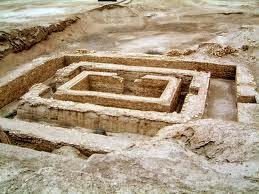
Cosmos shows, basically, four different arks.  The first is that of writing.  Tyson takes us back to ancient Uruk, humanity's first real city, established about 7,000 years ago.  About where As-Samawah is in modern-day Iraq (I hope we all know where Iraq is at this point).   Uruk was part of the Sumerian/Babylonian civilization that basically straddled the Tigris and Euphrates Rivers. Using the Euphrates River as a highway, Uruk depended on farming villages surrounding it for food and raw materials for the first urban lifestyle.  From Uruk, the world's first bureaucrats managed the agriculture, trade, religion and security for the region.

Uruk's DMV, where you could register your barge and get your oarsman license

Uruk has the great distinction of the being the birthplace of writing, the first "ark" Tyson covers.  With writing, a person's thoughts and information could be transported and transferred.  Harvests could be counted.  Receipts could record where produce went and how much was paid.  Rules could be made into laws, that could now be standard throughout an Empire.  Kings and their reigns could be listed.  Basically, with writing, came the invention of fame.


Uruk could also support religious authorities, one of which was an Akkadian Princess named Enheduanna.  Princesses could also be Priestesses at this time, and Enheduanna was appointed Priestess of the moon goddess Nanna.  It was a powerful position, and so given to royal women close to the king, which she was.  It was also a privileged position.  Not needing to actually grow her own food or make her own clothes or home, Enheduanna's main job was to keep religious power close to the throne, and write the world's first documented poetry.  She is the world's first known poet, mostly religious hymns and praises, but some autobiographical work.  She is long since dead.  But we still know her name, where she was from, who she was, who her family was, and what she did.  Her life story remains, long after she is gone.

The first Emily Dickinson?

Uruk also produced the world's first hero.  Before the Greeks' demigods or Ulysses, and our Kryptonians, there was Gilgamesh.  The hero of The Epic of Gilgamesh, he was revered as an ancient king of Uruk and son of a goddess.  The Epic of Gilgamesh details his travels, searching for immortality, which he didn't find.  But he did find an old wise man named Utnapishtim, who gave Gilgamesh the first Great Flood Story.  It's eerily similar to Noah's story, but much older.  Given the job by a god to fill a giant wooden boat with animals and his family, Utnapishtim survived a 12-day storm that covered land as far as he could see.  Three different birds had to be sent out to determine if there was dry land as the waters receded.  Utnapishtim counsels Gilgamesh to abandon the quest for immortality, as that is alone for the gods, so Gilgamesh goes home to face death.  But his story lives on, in the wide variety of super-human stories we tell each other today, replicating with tweaks through the millenia.

Every story is a re-boot of Gilgamesh's franchise.

Tyson continues to show another story that continues, with tweaks every generation.  It's the story of the molecules that live in each and every cell in every living thing.  And have replicated, with minor changes in each copying, through billions of years.  It's the DNA in our cells.  DNA is basically an alphabet of molecules, that we gave the letters A,C, G, and T. These four letters are repeated in varying sequences throughout two, spiralling strands linked by "rungs" of sugars and phosphates that form the structure's backbone.  Basically, DNA's job is to determine how each cell is made in order to do the job the cell will have to do.  The instructions for making every cell in our body are encoded in a huge sequence of four-letter words.  And the full instructions are stored in almost every single cell.  The helix only splits, giving half the sequence to one cell and half to another, in our sex, or germ cells, that will be used during reproduction.  This process of DNA (or RNA) creating new, self-replicating cells has been going on for 3.5 billion years.  The cells of your body are quite young; but the DNA, and the story of life it tells in those cells has been passed down from eons.

Those eons included tweaks, or copying errors in DNA, which produced the mutations that Natural Selection uses to shape living things for their environment.  If we go back through the history of life, we find that the earliest organisms were single-celled creatures that existed to make amino acids and proteins.  Where did they come from? How did the inert, non-living matter of Earth, 3.5 billion years ago, transition to carbon-based and replicating?  That transition is called abiogenesis, and it's the great mystery of our time.  We can, in a lab, recreate the conditions on Earth that existed at the time of the first known living things.  And those conditions, recreated, can produce the amino acids we need to form DNA.  But how do they form DNA and start a replicating process?  

Tyson explores the hypothesis that life originated elsewhere, and was literally carried here through space.  And he describes the arks that might have transported it.  In 1911, a meteorite fell to Earth near Nakhla, Egypt, which is near Alexandria.   The Nakhla Meteorite has the distinction of containing compounds that form in water, indicating that it came from somewhere that had water when the meteorite was first formed and sent into space.  In 1975, NASA sent the Viking 1 and Viking 2 probes to Mars, and when they landed in 1976, and began examining the content of Mars' atmosphere and surface, scientists figured out that we had a ton of Mar's materials on Earth, produced by collisions in the Early Solar System between Mars and other space debris.  When ancient asteroids with more power collided with early planets, including ours, it produced a debris field that drifted into space, to be pushed and shoved by the newly forming planets' gravitational fields, and would eventually orbit the Sun, until prodded by gravity to land somewhere else.  In other words, Mars was dumping its trash on our planet.


This includes the Nakhla Meteorite, which shows that Mars must have had water.  The Viking Probes found even more evidence of early water on Mars.  More importantly, it showed that materials can be transported from planet to planet, by arks called asteroids.  Could life have come to Earth this way?  It's possible.  Some Earth Microbes can survive in space, even for long periods.  Less than ten years ago, NASA sent up a sampling of Earth Microbes to live on the outside of the International Space Station, and found some still alive when they were retrieved and brought back to Earth.  These microbes survived the cold, the heat, the lack of any atmosphere, and the intense radiation of space.  But, could they survive the eons of space travel between worlds?  Maybe, they don't have to.

Planets dump their trash on each other in at least one other way, by the movement of stars and their orbiting planets around their galactic cores.  Our sun takes a Galactic Year of 225 million Earth years.  As it spins around, it passes through dust and gasses of earlier supernovas, where debris from previous solar systems is making its own, slower, trek around the galactic core.  Our Sun's gravitational field could easily shove a piece of galactic debris to one of it's planets.  And like our International Space Station, there could be small organisms surviving the radiation, cold, heat, and vacuum of space.  Were some of them the Earth's original inhabitants, finding Earth a great place to settle down and evolve?  Have Earth's ancient microbes seeded other worlds?

Tyson explores one way Earth has dumped on the rest of the universe:  radio waves.  In 1946, the US Army managed to bounce a radio wave "ping" off the moon, and hear it echoed back, from Belmar, NJ.  They called it "Project Diana".  However, radio waves expand, like ripples from a water drop.  Which means, that most of the radio transmission went past the moon, into space. As does every other single radio transmission ever.   Since the mid-twentieth century.  All of our music, our TV shows, and even communications.  Radio waves travel at the speed of light, which becomes about 6 trillion miles per year. That is about seventy years, or 420 trillion miles from us.  Some have, no doubt, reached planets surrounding other stars.  Is anybody listening?  We are.  

SETI is an acronym for the Search for Extra-Terrestrial Intelligence.  It takes a few different forms, but the one we're all familiar with was shown in Contact (a movie based on Carl Sagan and Ann Druyan's book) .  Basically, we point a radio antenna towards a star, and listen for any radio transmissions coming from it.  And like most radios, all we get is static.  Is this really the best way to detect other intelligent life over astronomical distances?  What if other intelligent species have moved on from radio waves, using some other means of communicating?  What if other intelligent species have short-lived civilizations?

Earth's past is full of dead civilizations.  Enheduanna and Gilgamesh's society died out thousands of years ago due to war, over-farming, and a drought that ravaged Eurasia.  Ancient societies of the Western Hemisphere were also wiped out by drought and the diseases Europeans brought during the Age of Discovery.  74,000 years ago, the massive, supervolcano Toba erupted and spewed sulfur clouds around the world, creating a five-year winter (no Starks, though).  Tools from the areas affected showed that humans survived, but their societies did not.  Our own Sun has about another 4-5 billion years before becoming a Red Giant that will, at the very least, make Earth a scorched hell.  Planets surrounding a Red Dwarf star are luckier, with Suns that can last trillions of years.

Will it be inhabitants of a Red Dwarf system that establish a new, interplanetary society?  Or, will humans survive, as we survived the Toba Volcano, and find a way off Earth before our Sun destroys it?  Will we repeat Utnapishtim's story, of traveling through an interstellar flood in an advanced society's version of an ark?

Let's hope so.

Life going on...

Tuesday, May 13, 2014

Nothing Is Too Wonderful To Be True - Cosmos - Season 1, Episode 10

Electricity.  It's all over the goddamned place, by just flicking a switch.  Or pressing a button.  But what is it?  And how did someone ever figure out how to use it?  The discoveries of electromagnetism were so important, Einstein considered their discoverer a genius.  So, Tyson spends an episode on the life of Michael Faraday.

Electricity is basically subatomic particles being either attracted to or repulsed from each other, depending on whether they have a positive or negative charge.  What's a positive/negative charge?  All about how many positively charged protons there are versus negatively charged electrons.  In each atom.  If the atoms happen to be metal atoms in the shape of a wire, a change in negative/positive charge sends electrons all along the wire.  That wire can be fed to a light bulb.  Or a computer.  But what starts the process of repulsing or attracting electrons?

Magnets.  And Faraday figured it out.  Born in 1791 in a tenement in what was then a suburb of London, he left school early due to a speech impediment, and never returned.  He eventually was apprenticed to a local bookbinder, where he could spend nights reading the books he literally made during the day.  He discovered an interest in scientific books.  Working at a bookbinder had its perks:  he received tickets, from a friend he met through work, to lectures at the Royal Institution, given by the Royal Society.  Covered before, in the episode on Isaac Newton and Edmond Halley (episode 3) , the Royal Society was Britain's collection of the most eminent scientists.

It included Humphry Davy, a man who had already discovered calcium and sodium, who liked to enliven his lectures on chemistry and electricity. Back then, electricity was produced with chemical batteries.  Basically, buckets of positively charged or negatively charged fluids connected by a conductive substance, so electrons can flow between them.  Over time, the chemicals transfer enough material (positively or negatively charged) so that the buckets have an even distribution of electrical charge.  Then the transfers stop, the power runs down, and you have to go get another battery.   Humphry Davy would use a basement of huge chemical batteries to power the show at his lectures, all so he could demonstrate a small light of electric arc current between two wires.  London was spellbound.  Faraday took notes.

Faraday, using his skills as a book binder, literally turned his notes into a book on Davy's lectures, and impressed him enough to hire Faraday as a temporary assistant when Davy injured his own eyes in a chemical experiment.  Faraday was so useful, Davy kept him on.  Faraday excelled at experiments to solve problems.  When William Wollaston and Davy couldn't figure out how to get an electrically charged wire to spin a magnet, Faraday went to work and built what is now called a homopolar motor:  a wire, extended into a pool of mercury that already had a magnet in the center.  If the magnet received an electrical charge, the wire would start to stir the mercury around the magnet, stirring the mercury in an unending circle for as long as the battery could charge the magnet.  Faraday created the world's first motor.  Every motor is essentially this, converting an electrical charge into some sort of circular motion that then drives another machine.

Build your own!

When Faraday published his work, Davy was furious for not getting the recognition he felt he deserved.  Davy punished/buried Faraday, by assigning him the task of making optical glass that could compete with Bavaria's (episode 5).  Faraday spent four years failing at this, until Davy died.  Four years of effort, and all Faraday had to show for it was a glass block of a failed optical glass recipe.  He kept it as a souvenir of his fruitless efforts.

After returning to the Royal Society's good graces in the 1820s, Faraday spent most of the rest of his career experimenting with the relationship between magnets, electric charges, and even light.  Faraday discovered that if he set up a spiral wire, and move a magnet in the center of the spiral, that creates an electrical charge. In other words, Faraday created an electrcomagnetic generator.

Ta Da!

So, not only did Faraday discover that electricity could produce movement, but that movement (of a magnet) can produce electricity.  The two (electricity and magnetism) were even more linked than previously thought.  Most of what we do now is figure out new ways to create some sort of movement with a charged material that produces electricity.  It's usually a turbine, which is any rotatable device, that has to be turned.  It can be turned with pressure from steam, gas, or water.  Producing the steam or gas is where fossil fuels have come in (from episode 9).

But Faraday wasn't done.  Despite memory problems that brought on bouts of depression, he decided to see whether light waves were effected by magnets.  By setting up a lantern with a mirror, he reflected candlelight through just about any chemical he wanted, set on top of a horseshoe magnet.  Reflecting the light off a mirror transformed the light (which scientists already described as a wave) waves from diffuse rays going everywhere to specific rays in one direction, which is polarized light. This light then traveled into a lens (a Nicol eyepiece) from which Faraday could examine the light.   This meant that not only did light pass through a transparent chemical, so did a magnetic charge.    

Faraday creating polarized light

But that's not all.  When Faraday took down his useless glass block sample from his souvenir shelf, he found that when light passed through the glass block when the magnet was charged from a battery, he got a perfect light wave through the Nicol eye-piece.  As long as the eyepiece faced him.  When it didn't, the light wave disappeared.  In other words, Faraday had discovered how to make oscillations of light waves. We call it the Faraday Effect. In other words, Faraday invented the signal that would one day be used for all telecommunications.  The magnetic charges had to be parallel to the direction of the light, leading Faraday to conclude that magnetic charges were really invisible lines.

The idea of magnetic charges as lines was as revolutionary as the technology that would later make cellphones possible.  No one at the time believed him, mostly because these lines are invisible to humans.  But we can know they exist for several reasons.  One, birds can detect them naturally, using them to differentiate between North and South for migration.  Two, birds can also detect, naturally, variations in these lines of magnetic force, and use those variations in place-finding, which is how carrier pigeons were used as communication devices until we had phones.  Three, that's how your compass works.  The magnetic pole doesn't "point north", it literally aligns itself with the lines of magnetic force that connect Earth's Poles.  This is because the middle of our planet is liquid iron.  That moves.  And what do we know about moving, negatively charged materials?  Why, they create magnetic fields.

Yes, we are surrounded by invisible circles.

Faraday eventually had help.  A man from a totally different background, raised by wealthy, doting parents as an only child, James Clerk Maxwell was determined to prove mathematically, what Faraday could only infer from experiments.  Using 20 variables and 20 equations, Maxwell used math to describe Faraday's lines of magnetic forces.  It was Maxwell, solving electromagnetism with math, who realized electricity and electromagnetic waves move at the speed of light, which is why we perceive it to be instantaneous.  Or, in the case of your satellite phone conversations, almost instantaneous.  The waves have to travel, literally, thousands of miles.  So, be patient.

Faraday, raised poor with almost no formal education, wasn't done innovating.  In 1825, while working for the Royal Society, he started a yearly tradition that continues to this day:  The Royal Society's Christmas Lecture,  a showcase of the Royal Society and science worldwide.  Faraday gave many of the early ones, until his death in 1867.  But the tradition lives on, with lectures by John Tyndall, David Attenborough, Carl Sagan, Richard Dawkins, Susan Greenfield, and Bruce Hood.  They lecture on their areas of expertise, from sound to light to biology to the search for other worlds.  And the kids get up close and personal.

Tyson ends with our world's oldest and best light show: the Auroras over both the North and South poles.  Our sun emits more particles than just light protons.  These particles carry their own positive or negative charges, and hit the Earth's magnetic lines of force, where they ride the line to either Pole and release their energy as light photons.  How fitting that Earth's best show combines light, magnetism, and electrically charged particles to demonstrate one of Faraday's most famous quotes:


 "Nothing is too wonderful to be true, if it be consistent with the laws of Nature."

Tuesday, May 6, 2014

The Past Is A Foreign Country - Cosmos - Season 1, Episode 9

Every day, we get up, go about our day, and then go back to bed.  Survival, for us, is relatively easy.  But, that is an exception.  For most living things, survival on any given day is not a given.  And if the environment becomes unlivable without enough time to adapt, your whole species can die out.

And for those humans who survive, it means that your perspective of existence is about 80 years.  Out of 13.8 billion.  We don't live long enough to perceive our origins, or how much in our universe has changed.  Our eyes can only see to a certain visibility, so everything at the atomic level appears invisible.  Our eyes can only see to a certain distance, so our universe looks much smaller than it really is.  In one lifetime, we'll only get the slightest glimpse of how the universe plays out.  Science can help us see into the past, see far away, and see down below.

Tyson starts in the Permian Period, about 300 mya (million years ago).  The constellations we know would not have existed.  Earth itself was unrecognizable.  Oh, it was blue and green, but Permian astronauts would have seen a very different world than what Neil Armstrong and Buzz Aldrin saw:

One continent.  Giant Bugs.  No cable.

Insects swarmed the Permian landmass known as Pangaea.  It was the last time our world was really united, and it created lasting mysteries in the fossil and geological record.  But how did we realize it existed?  How did we explain its forming, and its breakup?

The Permian diversity of life was made possible by a new innovation in living things:  trees.  Mutation at the molecular level produced lignin in plants, enabling them to be strong, yet bendable.  This allowed for plants to grow up, instead of out, collecting more light as they got taller and higher.  The result:  more trees made more photosynthesis.  And more photosynthesis produces more oxygen as its waste product.  Oxygen in our atmosphere abounded.  Any living things that survived by inhaling oxygen through their outer shells thrived, and had the potential to be huge.  Dragonflies had 24" wingspans.  

Yeah.  Go ahead.  Try the bug spray.

What happened to the trees, as they died?  Well, lignin was hard for animals and surface microbes of the time to digest, so the trees sat and decayed, leaving behind fossils for us to find.  Over time, they were buried, and the carbon dioxide in their decaying shells was buried with them.  The decaying process literally turned these dead trees into our world's current coal, oil, and natural gas supply.

Exxon is basically dead trees.

This awesome spectacle died, pretty quickly by fossil record standards, starting at about 252 mya.  With Siberia.  Basically, volcanoes set a huge supply of fossil fuel coal on fire over an area the size of Western Europe.  What is known as Siberia today literally erupted.  For years on end, volcanoes spewed lava and ash.  The lava alone covered about 2 million square kilometers.  The ash spread throughout the atmosphere.  Siberia's coal (a fossil fuel from all the trees) combined with the ash, produced sulphur and radioactive ash particles, aka coal smoke.  Imagine London, in one of their coal-induced pea soup fogs.  The haze blocked the sun and caused temperatures to immediately plummet.  But that's not all.  The CO2 realized by both volcano eruptions as well as the igniting of all that coal starting a chain reaction of massive global warming, soon overpowering whatever creatures hadn't died from the freeze.  

As the waters warmed, the change in surface water temps caused massive current changes, churning bottom and top water.  This churn, and warmer water near the ocean floor, melted huge chunks of methane ice.  And methane is an even more potent greenhouse gas.  As methane ice melted, then evaporated, our atmosphere retained even more heat.  In addition, methane gas then destroyed the ozone layer of the time, exposing all living things to the worst of the sun's UV radiation.  Eventually, oxygen literally ran down, as plants producing it died out.  It was like a perfect storm to end all life on Earth.  And it almost did.  The Permian-Triassic Extinction is the worst mass extinction known in our planet's history.  About 90% of our world's species died out.  Only small things lived, things that could survive the heat, the low oxygen, and the extra radiation.  Our planet's Tree of Life took about ten million years to recover.

Living things looked very different in a period of 10 million years.  So, our perspective of biodiversity is missing the branches lost from the Permian.  It requires careful looking at the fossil record to understand just how many different living things the earth can support.  But the fossil record and the geological sediment record seemed to be fucking with us. Fossils of identical animals could sometimes be found on both Africa and South America, from the same time period.  How could identical animals have lived at the same time across thousands of miles of oceans?  How could mountain ranges appear and disappear, and appear to cross oceans as well?

People have noticed, since maps were first made, that Africa and South America look like long lost puzzle pieces.  Abraham Ortellius, producing a map in 1570, guessed that the two continents were once united, and chalked it up to earthquakes or floods.  Alfred Wegner, an early 20th century meteorologist, guessed almost correctly, giving us the idea of continental drift, the idea that continents move.  But how, how does higher solid land move across the ocean floor?  With limited views of the world, without a proper idea of what was beneath our own feet, we could not imagine how Wegner could be correct.  

In 1952, Bruce Heezen and Marie Tharp collaborated on a project to map the floors of the oceans.  Using sonar onboard ship, Heezen collected data on elevations all over the ocean floor.  Tharp was restricted from conducting her own research onboard, as women were not allowed.  So, she took Heezen's data and processed it in New York, producing the maps.  Marie noticed a mountain range right smack in the middle of the Atlantic Ocean, now called the Mid-Atlantic Ridge.  First publishing a map of the Atlantic Ocean floor in 1957, they produced a truly worldwide map of the world, showing ocean floors as well as landmasses, in 1977.

Our real world

Once you can really see the world, you can literally see how it's stitched together, usually in our oceans, but also along the Pacific Coasts of the Americas and Asia.  Like stitching on a baseball, these are the tectonic plates of Earth's crust.  The crust of our planet, is like an eggshell to an egg- a very thin surface over all sorts of activity deep inside.  This includes our liquid and solid cores, made of iron and other heavy metals, as well as an inside layer of mantle, literally hot lava under the crust, filling in the space between core and surface.

Basically, anything orange and red.  We live where it's blue.

The mantle is constantly churning crust, because it's fucking hot and kind of liquid.  The crust resists.  Depending on who wins, the mantle or the crust, and how much energy has built up in their shoving match, landmasses can split or be scrunched together.  

Just watch the movie.  It's in color.

It requires something else to understand how our landmasses are shaped, and the effect on life that has.  Not as catastrophic as the Permian Extinction, the breakup of Pangaea started about 175 mya.  First, north broke off from south, into Laurasia (North America, Eurasia), and Gondwanaland (South America, Africa, Antarctica, Australia).  Then, east and west split, as the Americas drifted together, separated by a sea where Central America is now, water moved around freely between Atlantic and Pacific.  Plate tectonics changed that, shoving Panama up from the ocean floor where it is now, creating the ocean currents (and associated air streams) we currently know.  

Plate tectonics created the Mariana Trench, about 6 miles deep (height of Everest, but inverted), with water pressure at about 8 tons per square inch.  You and I can't live there, as it's too cold, too dark, and would crush us like bugs.  But other things can.  Lots of things.   Without light, the animals of the deep produce their own through bioluminescence, which is using pigment, an enzyme, and oxygen to make light.  Without plants, the bottom of the food chain hangs around vents in the ocean floor, imbibing hydrogen sulfide.  

As if below isn't bad enough, above is even crazier.  Venus isn't large, but it's close (relatively).  Jupiter and Saturn aren't close, but they're fucking huge.  Their gravity pulls and pushes at Earth, affecting our tilt and our orbit, creating the Milankovitch Cycles.  Even a small change can produce an Ice Age, with glaciers covering about half of the Northern Hemisphere.  But we've survived them.  As a species, not as individuals.  The last ended about 20,000 years ago.  But we have no records from our ancestors about surviving them.  We had to learn about them from fossil and geological records, which are the true survivors.  The next isn't expected for another 50,000 years from now.  Tyson hints that the Halls of Extinction have our next chapter.  Well, not ours.  So, about 70,000 years will exist, in which humanity has a nice weather window.  On a 4.5 billion year-old planet.  In a 13.8 billion year-old planet.  Our tiny perspective is from when the sun is shining, not from when the perfect storm comes.