Thursday, July 31, 2014

Selling Yourself - Legend of Korra - Season 3, Episode 2

Who's ready for a whirlwind tour of the Earth Kingdom?  Asami is!  I guess after Varrick gave her back control of Future Industries at the end of Season 2, she whipped everything back into shape in no time.  And got all her awesomely cool toys back. She shows up with their ride and digs for the trip- a souped up, luxury zeppelin, called an airship.  Asami is back to treating everyone in style!  The team is optimistic about their trip.  Tenzin and Korra can't wait to see the Airbenders being talked about all over the Earth Kingdom; Bolin is excited to be going anywhere.  Jinora looks like she aims to find herself during the trip.  And Bumi is looking forward to whatever it is Bumi looks forward to.

Who wants to ride in my awesome airship?

There are some not going;  Kya and Pema will stay to take care of the baby, whose name I'm not learning until his crazy eccentricity is revealed.  Kya is introduced to babies by being vomited on by the baby, and Pema is right there to gloat over it.  Kya takes the incident well, considering she can always wash herself off without using her hands.  Ikki and Meelo are at first indignant they can't come. Even good old Poki the ring-tailed lemur is indignant.  But Kya mollifies them by informing them that more air benders are out there, and some will show up at Air Temple Island.  And they'll need someone to show them where the bathrooms are.  Meelo is excited at the thought of new students for him to boss around.  Ikki can't wait for company.

They're not the only ones staying behind.  Mako shows up with a scroll slung on his shoulder, but it's not for him;  he hands it to Korra, making sure to only address her in her official capacity as the Avatar.  Korra at first thinks it's funny to humor this, and she's pleased that Mako's made a map of where reports of new air benders came from.  She's not so pleased when she realizes that Mako's not coming.  In his defense, he does have a job that requires showing up.  Mako is getting ready to head back to Republic City when Bolin waylays him and guilts him into coming.  Bolin achieves this with a drama queen re-enactment of possibly meeting their father's mother in Ba Sing Sei and having to watch her die if Mako isn't there too.  Mako, who doesn't look like he ever expects to see any relatives ever, goes simply to shut Bolin up, complaining as he agrees that his boss isn't going to like this.

But Mako, what if you kill Grandmother?

As Team Korra lifts off and watches Republic City get smaller and farther away, a small motorboat brings a single man of the Order of the White Lotus to a wooden platform, secluded in the middle of the ocean.  It's a completely-made-of-wood setting for a wooden cage in which resides one extremely muscled and tattooed man.  Will flowing locks of black hair.  No metal, no rock anywhere in site.  The guards notice the approaching boat and think it's their shift change.  Who's here?  Zaheer!  He leaps out of the boat, with his spiffy new air bending powers, and has a little fun with the guards, as he tosses three medium sized rocks into the wooden cell.  The prisoner looks down and smiles.

Don't mind me, I'm just escaping

As Zaheer distracts the guards, the prisoner bends the rocks, and melts them into molten lava, then molds them into a shuriken, three curved blades joined together to make a center.  Sending his new toy out, the prisoner slices open the wooden cell in three cuts, and leaps out of his cell, creating pandemonium.  After defeating the guards, he greets Zaheer and asks about the new talent.  Zaheer informs him that he's been able to air bend since Harmonic Convergence.  What's more, Zaheer is convinced that gaining air bending is a sign.  From someone.  That he and his buddy, Ghazan, are doing the right thing.  Remember that.  Zaheer thinks he's the good guy.

How can we not be the good guys?

While prison breaks abound, Team Korra lands in the Earth Kingdom, at the first location on Mako's map.  As they land, the map pops up, showing a team in an airship floating around the map, all with excited smiles.  And Tenzin is rarin' to go once they land and are greeted by the local mayor, who's set up a dinner with Ku An, a local farmer who's been air bending as a hobby since Harmonic Convergence.  He's happy to meet Avatar Korra and Master Tenzin, and happy to screw up his air bending in front of them, all the while pretending not to love being a local celebrity.  But he's not so happy to find out that Tenzin and Korra want him to pack up, leave home, travel to the Northern Air Temple, and become a Air Nomad.

Yeah, I think I'll pass on being a monk with no stuff

Tenzin dismisses every reason Ku An gives for staying.  What's a farm compared to resurrecting Air Nomad culture?  Why would a man stay with his wife and kids and the only life he's ever known?  Tenzin is amazed that he's not aching to leave everything behind for the amazing life of an Air Nomad.  Korra tries to be polite, but her speech doesn't work on the kids, who don't want their dad to leave, either.  And Ku An's wife isn't pleased when Tenzin insists that she should be fine with her husband ditching her.  The dinner ends with Ku An kicking them out.

Back at the airship, our plucky gang tries to regroup.  What went wrong?  How could an airbender reject coming to a faraway temple, without his family, and learn about a culture he neither grew up in nor cares about?  Why would he want to leave his farm?  Doesn't he know there's a wonderful and totally alien life waiting for him if he gives up his old one?  Totally oblivious to what exactly they're asking of people, all except Mako strategize for future visits.  The idea to simply kidnap air benders in a potato sack and draft them as Tenzin's students is rejected, but only barely.

The journey to Earth Kingdom villages on their way to Ba Sing Sei goes pretty much like the dinner with Ku An, except Tenzin doesn't even get into anyone's house anymore.  Why?  He's got such a great life to offer air benders- you get to shave your head, wear a uniform, have few if any possessions, and meditate constantly.  If you advance enough, you'll even get some funky tattoos and a flying pet too big to fit in your house!  Why do people keep slamming their doors in his face?  He's got so much to offer the comfortable villagers of the Earth Kingdom!  Team Korra's map slowly shows a team going from happy to heartbroken.  All along their tour, they haven't gotten a single airbender to come with them.  Korra tells Tenzin to leave this last one to her.

The last one is a millennial with no ambition, and no desire to even move out of his parents' basement.  Mom is ecstatic that Avatar Korra has come to take him away, but he has no desire to go anywhere, do anything, and doesn't care about his airbending.  Korra takes to scolding him right away, completely flustered by his apathy and simple declarations that, actually, he doesn't have to care about the world, or balance. And neither does Korra.  Korra is horrified by his declaring that, actually, Korra doesn't have to work to achieve balance.  The guy doesn't seem to care about chaos; but then again, he gets to live in a rent-free orderly basement maintained by his parents.  How would he like the chaos of homelessness?  When Korra tries to angrily carry him away, the guy finally decides to use his new air bending to blow himself away from Korra.  Mako and Bolin end up dragging Korra away, while Mom can only bemoan still having her son in her basement.  Good luck with him, lady.  Maybe Zaheer should have come along to bust him out.

Dude, your mom's basement isn't that awesome

Contrast this homey situation with the next prison break we get to see.  Deep in a fiery pit, a single cage is suspended, currently occupied by an armless woman.  Ghazan and Zaheer sneak into the prison, using their new bending skills, and smuggle in water in a barrel, which Zaheer shatters within bending distance from the armless prisoner.  She immediately leaps into action, bending the water into prosthetic arms for herself.  And these are spiffy arms:  they can slice open her cell, swing her around, and climb back up the outside of the cage.  Her water arms can be like whips, or she can swing herself around the entire pit within moments.  When the guards are finally knocked out, she stands and happily tweaks the guys who just helped her escape.  Calling her Ming Hua, Ghazan and Zaheer are unfazed by her teasing, and Zaheer happily informs her that they're going to get his girlfriend next.  Oddly, she doesn't ask about the air bending.

Somebody make these for real, right now!

Too bad, because I think Team Korra would gladly take Zaheer at this point.  They are now completely dejected, with Tenzin still not seeing that the life of an air nomad is... well.. an acquired taste.  Bumi wonders if trying to sell the lifestyle could use some "razzle dazzle", and Bolin is on board, urging the team to put on a demo of what happens when air benders get some training. Make air bending look cool- maybe people will want to learn about it then.  Bumi was really just going to bedazzle Tenzin's jacket, but he thinks Bolin's idea is great.  Tenzin and Korra are actually ambivalent about making air bending look interesting for a crowd.  And the display they put on the next day, at some anonymous town in the Earth Kingdom, is as schlocky and tacky as they come.  Tenzin goes shirtless, maybe to look like a badass.  Bumi demonstrates that air bending is easy for novices to learn.  Bolin, as ringleader, wears a fake mustache and plays up everyone's performance.  He bamboozles the crowd into thinking a dangerous fire bender is nearby, one who just happens to be milling around in the crowd, and looks suspiciously like Mako.  When Mako appears, he deadpans his lines, and shoots up a pathetic puff of fire from his fist.  The crowd still loves the show as Avatar Korra uses air bending to "apprehend" Mako, and even uses some surprise moves, so she and Asami can get a kick of out startling Mako.

The crowd, though entertained, breaks up when the show ends, and Team Korra is left with one tweenie.  With his backpack, he's all ready to go with the team.  They're a little incredulous at first- is he sure he wants to live in an Air Temple?  But the boy, named Kai, is downright enthusiastic about leaving.  Right away.  When someone asks about Kai's parents, he launches into a teary description of a ruthless gang that killed his parents and are chasing him.  The group swallows it, except maybe Mako, who has yet to be enthusiastic about anything they've been doing.

Oh yeah, you're conveniently free to just come with us right now...

As everyone files back onto the airship, with Kai, some rough types show up on motorcycles, and shout out to the airship that they want Kai, and no one's leaving with him.  Korra, defender of everyone she thinks needs her help, marches out and promptly kicks their asses.  So, imagine her surprise when she finally spots the leader's badge.  Turns out, he's a cop, Kai's a thief, and his whole story was a lie.  Except for being an orphan.  He is.  But he's on the run after conning an adoptive couple out of their valuables.  When Kai can't be found, it's Mako who rejoins the group, lugging Kai and Kai's stolen goods back with him. As the cops lead Kai away,  Korra makes a decision.  Telling the cops to return the stolen goods, she offers to take Kai and raise him to abandon his life of crime.  Tenzin objects at first; can a liar and an thief really make a good airbender?  But Korra convinces him to agree to take the boy on.

However, that doesn't mean that Tenzin is going to like that arrangement; he snaps at Jinora when he catches her flirting with Kai and Kai flirting back.  Bolin is thrilled, already calling Kai his little brother.  But Mako makes sure to have a little "talk" with Kai, which is really just a series of threats if Kai doesn't stay in line.  Considering Mako and Bolin's past, as orphans with long criminal histories, Mako probably thinks he knows Kai and what he'll try to get away with better than anyone.  Maybe Mako, deep down, wishes someone had kept him honest as a child.  The speech also reminds one of Katara's "welcome" to Zuko when Zuko came to teach Aang waterbending.

Future best buds

We return to the prison of the fiery pit, where the Order of the White Lotus has to explain to a disappointed Fire Lord Zuko that Zaheer, Ghazan, and Ming Hua have all escaped before anyone really knew what was going on.  The poor schlepp also has to inform Zuko that Zaheer was air bending.  Zuko, seeming to know exactly what to do, tells the guard to call Republic City and put extra guards on the Avatar.  When the guard asks where Zuko is going, Zuko's response is to mount his ridiculously awesome dragon and tell the guard he's going to the Northern Water Tribe to talk to the chiefs there (guess who?), because he knows where Team Zaheer is going next.  Zuko then rides off, his dragon speeding away so that Zuko can get all Fire Lord on Zaheer's ass.

Consider his ride pimped.

Monday, July 28, 2014

Told By A Fearful Body - Legend of Korra - Season 3, Episode 1

Well, the gang has all returned to Republic City, or at least most of the gang.  The Wonder Twins have, presumably, returned to the Northern Water Tribes to break the "bad" news to their family about Unalaq.  And Varrik is who knows where, presumably with his loyal assistant Zhu Li.   Tenzin's family has returned to Air Temple Island outside Republic City, and Uncle Bumi and Aunt Kya are staying with them.  Spirits now roam throughout the material world, since Korra left last season with leaving the portals open between the worlds.  And not everyone's happy about it.  In fact, both spirits and humans seem to hate each other already.

Bumi is obviously up to important stuff, chasing his spirit buddy, Bum Ju (yes, that is short for Bumi Jr.), who he met during Harmonic Convergence, around Air Temple Island.  We find out, that Bumi just wants his spirit buddy to wear a sweater Bumi knitted.  The spirit buddy has shown enough sense not to ever wear anything Bumi makes by leading Bumi on a merry chase around the island, culminating in a tense standoff while Bumi hangs onto a tree growing over the edge of a cliff.

Just not a sweater guy

Bumi surrenders too late;  the tree branch he's on breaks and he plummets to the rocky ground below.
Just a couple feet above certain death, Bumi forces his hands forward, and out comes air!  Bumi is saved by a mini-ball of air supporting him.  Bumi realizes that he just unintentionally bent air!  He's ecstatic, but one can't help wondering if his spirit buddy maybe knew all along, and lured him over that cliff so that Bumi could learn the good news, too.

We catch up with Korra, Tenzin, and Jinora in Republic City, and Korra is frustrated.  Since leaving open the portals, enormous, unexplained vines have grown all over the city, rising to the tops of building like ivy.  The vines have created ecosystems within Republic City perfect for spirits, but really sucky for people, so, it's been Korra's job for two weeks to get rid of them.  Fire, as we see, doesn't work.  Jinora, cuddling with some spirits accompanying them, questions even trying to remove them.  Tenzin, after witnessing Korra defeating Unalaq, is confident that Korra will solve this problem.

When life hands you vines, grow grapes

He's the only one with total faith in Korra.  Even Korra doubts she can remove the vines.  And Republic City's news reporters have questions that show the entire city is sick of waiting and seeing.  President Reiko decides not to so much answer any of their questions, but instead just point out that Avatar Korra is to blame for all this, just as Korra appears at his side.  Korra, in typical Korra fashion, lashes out at the man who gave her no backup in the fight against Unalaq.  She reminds Reiko that the city wouldn't even exist anymore if not for her.  They're about to get into it with reporters watching, when Lin Beifong, still Police Chief, breaks it up.  Asami emerges from the disappearing reporters to try to cheer Korra up.

Why don't you just go climb the tree in your office?

Tenzin, meanwhile, has taken Korra, Asami and Jinora back to Air Temple Island for what I'm guessing is lunch.  On their way in, Bumi waylays Tenzin to give him exciting news.  He rushes everything out as if he's a five-year-old, and Tenzin treats him like one.  As Tenzin's whole family proceeds through the hellish ritual that is a family meal with young children, we see that Bolin is there too!

Aren't family dinners supposed to be good for you?

Bolin is asked about Mako, who Bolin says has stayed behind in Republic City, sleeping at the Police Station after work, since seeing just about anyone is awkward for him at this point.  Bolin drives the point home by impersonating Mako as a brooder with bad hair.  Bolin is in a fine mood, waxing on about how Tenzin's family contains every Crazy Family Stereotype.   Bumi has been staring at a napkin during this, but interrupts Bolin to point out that he moved his napkin.  Tenzin furiously tells Bumi to grow up and stop telling tall tales.  Bumi decides that the real problem is that his life isn't in danger, but Pema nixes Bumi's suggestion that Bolin attack him with a bolder.  Meelo has no such self-control, and excitedly hurls a dinner plate at Bumi's head.  Just as before, Bumi throws his hands in front of his face, and ball of whirling air envelopes the plate, spinning it inches from Bumi's face.

Wait, Bumi's not crazy????

The table is stunned. Even Meelo, who actually threw the plate.  Bumi is triumphant, declaring that he'll tell their mother, who will be so proud of him.  But, it doesn't last.  Bumi's airball runs out of air, and the plate crashes on the table.

We segue back to Republic City, where Mako is back at work, as a dedicated public servant of the police force.  Roused from sleeping under his desk, he answers a call to a bookstore, managed by two brothers for years.  The place is a wreck and one of the owners is frantic, claiming an argument became a storm.  Mako is confused, and even more so, when the man claims his brother was air bending.  Sighing because now he's got to get to the bottom of this, he proceeds to the room the so-called air bender locked himself into.  Mako is trying to keep calm, but the brother is scared of hurting anyone.  Mako threatens to break the door down, but that just ends up triggering a blast of air that blows the door off its hinges and right into Mako, throwing him across the room, buried under the door, as the air-bending brother races off, blown away by yet another gust of wind.  The first brother, bending over a recovering Mako, basically says I-told-you-so.

Back at Air Temple Island, Bumi desperately flails his arms and legs in futile attempts to consciously air-bend.  Its useless.  Korra and Tenzin try to theorize why Bumi might be air-bending now, but neither has an answer as both Mako and Lin Beifong quietly walk up to the family with no greetings to or from anybody.  When Lin Beifong mistakes Bumi's practicing as one of Bumi's crazy recreational activities, Tenzin has to give her the stunning news.  Except that the shared look between Mako and Beifong says that it's really not so stunning after all.  They share Mako's information with Tenzin and the rest.  Korra also tries to get Mako to come and stay on Air Temple Island.  Mako, wishing he was anywhere else but facing two ex-girlfriends who want him to move in, explains that he's doing important work.  The awkwardness ends in a completely unnecessary salute from Mako.

Korra and Asami, about to drive around looking for the mystery air-bender, decide that it's time for Korra to learn how to drive.  A stick shift.  It's not pretty, with Korra mistaking the brake for clutch.  They share some jokes at Mako's expense, and each ends up confessing that Mako kissed her while he was going out with the other.  Why they don't jointly realize that Mako is a total dog, but instead share a laugh over lost loves, is beyond me.  They have no time to realize the sad truth about Mako, as they've been missing the huge vines growing right in the road, which Korra barely misses.  Before they can be relieved, a porcupine spirit emerges from the vines, and Korra loses her calm.  She insists that the porcupine get rid of the vines, telling him that this is supposed to be a place for humans. The spirit insists that they didn't create the vines, and disdainfully tells Korra that spirits and their habitats can't be considered separate entities.  He implies, the snooty tone we've all come to know from spirits, that Korra should already know that.  She didn't, but she's suddenly inspired with an idea for getting rid of the vines.

Don't look at me, lady, I'm just a tenant

The kids, back at Air Temple Island, ambush Tenzin with questions.  With new airbenders, their lives could change, and they're ambivalent.  Ikki insists that she's not sharing her room with new recruits;  Tenzin tells her she'll keep her own room, but the Island itself will probably become more crowded.  That's fine with Meelo, who dreams of commanding an army of air benders.  Jinora schools him on air bender societies not having armies. Tenzin agrees with Jinora, but he gets a little misty-eyed as he wishes they get enough air benders to fill the temples around the world.  Meelo wants his dad to be their boss, but Tenzin is more worried about being their guide.  Meelo, with his grandfather's imposing statue behind him (somehow fixed right away after Unalaq destroyed it, I might add), tells his dad that the kids will help.  Oh joy.

Korra, meanwhile, approaches a vine-covered building in Republic City, a building built along a canal with plenty of water.  As she's about to begin her experiment, Lin Beifong and Bolin by her side, a crowd forms behind her.  It's President Reiko, with reporters.  Perhaps feeling that she needs supervision, or hoping she'll fail so Reiko can keep blaming her for the City's problems.  Korra demands that the reporters shut up, and turns to face the vine-covered building.  She bends water into tentacles that soon circle the whole building, and turns the water to spirit energy.  The vines respond by retreating back into the canal with her water/spirit energy.  She humbly bows to the vines, wishing them peace.  All are stunned.  The reporters dash to Korra, and are about to worship her, when the canal erupts, vines literally throwing themselves back around the building, covering even more of it, and the building on the other side of the canal, for good measure.

In fact, so many vines pull the other building, it's about to topple over.  Lin Beifong and Bolin react quickly, sending stone support pillars up to hold up the building so Korra can evacuate everyone inside, including a kid stuck in the upper stories.  A turret falls on the street just as Korra gets out from under it, and a crowd forms around the disaster.

Oh, I'm gonna' look like an idiot now...

Korra reverts to meditating, in an attempt to contact past Avatars.  However, they are still gone, just like Korra declared they were after defeating Unalaq.  Tenzin interrupts, but Korra's fine with giving up anyway.  Without past Avatars, can she even go into the Avatar state anymore?  Korra doesn't whine about losing her connection to the past, mostly because it's her own fault.  Instead, she bemoans her pariah status in Republic City.  Tenzin reminds her that she's not an elected official.  She has another job, which is keeping the world's powers in balance.  Sometimes, to restore balance, change must come.  And not everyone is going to like that change.  But what people "like" isn't necessarily Korra's problem.  Balance, Tenzin feels, might just be its own reward.  When Korra complains that she almost never knows what to do, Tenzin tells her that true wisdom is realizing what you don't know.

Bolin interrupts them with a rushed speech that he realizes too late is pretty rude. The police found the other new air-bender,  who has now climbed to the top of the bridge, begging the police to not approach him, and blasting them off the bridge into the bay when they don't listen to him.  Korra approaches from the air, and Mr. New Airbender can't ward her off.  She settles on the bridge with him, and tells him that there are people who can help him with his new powers.  Mr. Newbie wants his old life back; Korra tells him that might not be possible, but he should be taken to the Air Temple Island and just talk to the people there.  He doesn't sound optimistic, and then falls off the bridge. Korra, totally in control, saves him from falling onto the roadway, to the crowd's relief.  Tenzin warmly and kindly greets Mr. Newbie, who has gotten his stuff together enough to crack a joke about needing a diaper change.

Despite Korra saving the day, President Reiko is not pleased.  He's furious that Republic City just seems to be going from one disaster to the next, and blames Korra, banishing her from Republic City.  Korra, stoic, agrees that she'll be going.  She turns to Tenzin, and seems happy when she tells him that her new mission is to find these new air-benders, and get them to Tenzin.  Tenzin informs Korra that she won't be bringing anyone to him, because he's going with her.  This episode shows how the bond of Tenzin and Korra has grown; he's never exasperated with her, and knows now to follow her instincts. Korra has learned to stop resisting Tenzin's lessons, and can benefit from earning his loyalty.  Both seem completely unfazed by Reiko's banishment of Korra.  They've got a mission to look forward to; one only an Avatar and master air-bender can undertake.  Tenzin is already daydreaming of new and wonderful air nomads.

Far away (we think), in a mountainous country, where jagged rock-bergs jut from the sea below, a lonely prison cell is getting a visit.  It can only be reached by a bridge, that can only be extended by metal-bending.  A few members of the Order of the White Lotus approach, one with a tray of food.  They have a leader who lacks enough sense to wear a helmet.  He shouts at the prisoner, named Zaheer, to go to the back of his cell, and face away from the barred door.  The guard deposits Zaheer's meal through a slit between the bars.  A setup to show that this Zaheer is considered a dangerous man, who needs a cell in the middle of nowhere that is unreachable for normal people, with highly trained bender-guards.

Zaheer is a grizzled man, not young but not old.  And he is perfectly calm.  He decides now is the time for philosophy, and asks if the guard knows of Air Guru Laghima.  Apparently, legend has it that Laghima was so in tune with air-bending, that he one day rose from the ground and never touched it again.  Zaheer is particularly obsessed with one of Laghima's sayings:  "Instinct is a lie/ Told by a fearful body/ Hoping to be wrong".  Zaheer interprets it to mean that what you see doesn't even begin to describe the universe, and if you base your expectations on what is seeable, you can be taken by surprise.  By, say, a prisoner who can suddenly air-bend.  Zaheer blasts air at his guards, blowing them back far enough from the door so he can escape.  One by one, the White Lotus guards, despite bending fire and earth and water at him, can't touch him as he glides and somersaults his way around all elements and guards.  One by one, the White Lotus guards are blown into Zaheer's old cell, and then Zaheer blows the door back in place, leaving his guards with his meal as their only food.

He has a very special set of skills

The leader of the guards demands to know what Zaheer plans on doing.  Formally announcing that he's the bad guy of the season, Zaheer outright tells them that he can see a future without the Order of the White Lotus.  And without the Avatar.  He leaps off the rock-berg for who knows where.

Notice that, unlike last season's cat and mouse with Unalaq, where we suspected he was trouble, then realized he was evil, then realized what he was really up to, Zaheer is announcing his intention to rid the world of the Avatar outright.

And now on to a final thought.  There's another interpretation of Laghima's poem.  "Instinct is a lie/Told by a fearful body/ Hoping to be wrong."  Your fears will try to hold you back.  But inside, there is a part of you that hopes you won't listen to your fears.  Is that the real lesson to be learned this season, as Korra's world grapples with the changes of integrating the spirit and material worlds?

Friday, July 18, 2014

Welcome to Self-Awareness - Dawn of the Planet of the Apes

It's a tale of lost hopes, for both apes and humans.  Both communities fray and come apart, with disastrous consequences for the other.  Both communities have leaders bickering amongst each other, for war and for peace.  The human community is desperate for electrical power, and willing to kill to get a hydro-electric dam the apes live next to working again.  The ape community doesn't trust humans, after being treated cruelly in various forms of human captivity.  The humans mistakenly resent the apes for the simian flu that wiped out the rest of humanity, sinking them back into the dark ages.  Neither community has any good feelings for the other.

Warning: Obvious Animal Farm Reference!

They meet without expecting too, in an ugly incident that scares and angers both communities.  The human leaders and apes set conditions that our plucky band of human heroes struggles to meet as they work, sometimes together, to repair the dam and turn the generator back on.  There's oohing and aahing over a baby chimpanzee that almost brings apes and humans together, until another ugly incident almost ruins their plans for the damn.  There's a human who saves the life of one of the females who has just given birth, which gives everyone the chance to finish the task despite mistrust and anger.  There's Maurice, a gentle orangutan, wiser than the others, who finds himself interested in the humans and their books.

Shared baby love!

The main conflict of the story is between Caesar and Koba, two chimpanzees leading a band of a few hundred chimpanzees (calling them chimps when they can talk just seems like a slur).  There are human conflicts, especially between Malcolm, leading the human team to restart the hydro-electric dam, and Dreyfuss, wanting electricity and contact with the world outside San Francisco at all costs.  Carver, a jumpy, gun-toting fool, is in conflict with the rest of the dam team and the apes.  These conflicts fade as the other humans Malcolm disagreed with die during the film. Caesar and Koba's falling out, Koba's vicious betrayal, and Caesar's justice in the end, slowly take center stage.  As apes, they have a distinctive way of showing who owes loyalty to whom.  As Caesar and Koba's deep friendship turns to hatred, their "handshakes", showing Koba's loyalty to Caesar, and Caesar's trust of Koba, become briefer.  As Koba brings vicious, Game of Thrones-style plotting to ape civilization, Koba also hoodwinks Caesar's teenaged-son Blue Eyes, who realizes almost too late that he owed his father his loyalty all along.

Koba has good reason to hate humans, as he spent his early life as a test animal in a lab, basically being tortured in the name of science.  Caesar, as the adopted "child" of a researcher from the lab, has every reason to think there are good humans, even if they can be annoying.  Blue Eyes has almost never seen a human, and is a new generation of chimpanzee, who only knows of human mistreatment and civilization from stories.  He and his teenaged buddy, Ash, are prime for Koba's schemes.  As Koba's paranoia and hatred for humans puts him in conflict with Caesar, and with a small group of apes still loyal to Caesar, Koba becomes what he hates in humans.  However, since this leads to a ridiculously awesome shot of Koba riding a horse and firing two machine guns while a fire burns all around him, it seems like the conflict was worth it.

Holy fuck, yes, totally worth it

Not so for Caesar, even though he eventually wins his conflict with Koba.  Not so for Malcolm, though he and Caesar are best buds at the end, and the humans captured by Koba have been freed.  Not so for Blue Eyes, who will lose his friend Ash to Koba's greed for power.  Despite the stalemate fought to between humans and apes, the war is just beginning between them.  Caesar declares, at the end, that the apes started this war, but it's easy to point fingers at humans who unknowingly played right into Koba's hands; Dreyfuss, who wants to invade and slaughter the apes if they won't allow Malcolm's team to save the city; and Carver, who breaks the apes' conditions and is forced to admit being a total asshole by literally every other member of the human team.  There were apes who were more than happy to march to San Fran with Koba for revenge; but they lost their taste for blood early, and didn't want to kill scared and obviously innocent humans.  

Despite Caesar's hopes for a Great Ape Society, peaceful and strong and intelligent, their society is now one where apes will plot against each other, hurt each other, even imprison each other.  Malcolm must accept leaving his home, just after re-establishing electrical power and thinking his human settlement was finally safe.  When Caesar and Malcolm part at the end, after the ape version of a hug, both have accepted that, despite their friendship, their societies will never be the same, and never get along.

Actually we're all apes.

Monday, June 16, 2014

I'll Live Longer Than You - Game of Thrones - Season 4, Episode 10

This episode, named by HBO, "The Children", basically shows the kids are taking over.  Whoever started the season as a loved child, or a spoiled child, an abused, or ignored, or abandoned or sold-to-horse-fighter child is now a grown up, no longer just trying to survive a story made by their elders, and officially taking over their futures.  

After teasing us last week with some barbaric kill or be killed scenario between Mance and Jon, the two end up drinking Free Folk Liquor, which Jon probably should have expected to be harder than Westeros wine. Bodies in the snow are covered in crows feasting away, and from the top of the Wall it looks like a vicious ant battle.  After trekking through the remains of last night's battle, which are like a morbid, sick, party mess,  he peacefully surrenders to the Free Folk in the forest bordering the Wall, and he and Mance commiserate over their dead, and especially Ygritte.  Mance, despite knowing he shouldn't have trusted Jon, really thought that Jon would have at least stayed loyal to the Free Folk for her sake.  He razzes Jon for breaking his chastity vows (vows Jon's just heard he didn't really break on a technicality).  Their real grief is reserved for the King of the Giants, and the six Brothers he took with him at the inner gate.  Jon and Mance toast fallen friends, and it's obvious that the two are just going to continue fighting because that's what everyone's here to do.

Pointless wars are always the best ones!

Their hearts aren't really in it.  And, both know how pointless the fighting is; Mance doesn't want the Free Folk to be killed and re-animated as undead warriors.  Jon doesn't want 99,000 Free Folk turning into White Walkers that will be harder to kill.  Mance doesn't want to destroy the Wall he's hoping will protect the Free Folk. Their confab, as each tries to negotiate despite having a shitty position, is cut short when Jon tries to knife Mance and fails.  Mance isn't angry, he's just disappointed, insulting Jon's and the Night's Watch honor for trying to assassinate him in his own tent during a peace negotiation.  This confab is further interrupted by two flanks of cavalry riding through and killing Free Folk at will.

It resembles, if nothing else, the end of Monty Python's Holy Grail, where King Arthur almost storms the castle until he's interrupted by cops arresting John Cleese, and the whole thing ends right there on the field with a confused mob of cops, actors in Arthurian garb, and various reporters.  Stannis doesn't actually fight, and neither does Mance, who now realizes he and the Free Folk are fucked.  After a horseman slices down a stray Free Folk, Stannis just appears behind his cavalry, with Ser Davos telling them all how to address Stannis, and Mance deciding he'll die free rather than kneel, and giving Northern Fashion Advice.  Luckily, Jon Snow introduces himself, and uses the my-dad-died-for-you card to get Mance only captured.

The conversation between them brings up a new sticking point.  Sure, Jon could let them through.  But then, the North would be full of people with no intention of bowing to whatever King rules.  Which is not the deal.  Being on the safe side of the wall means kneeling for the King's protection.

The entire Stannis clan, including Selyse and Shireen, turns out for the funerals of the Night's Watch Brothers.  Master Aemmon praises the fallen Brothers for dying with no hope of glory or reward.  Everyone else quietly sets the bodies on fire and watches them burn.  Ser Alliser Thorne isn't among the bodies or the mourners, although Janos Slynt somehow has totally forgotten what a useless coward he is, and Samwell doesn't seem interested in spilling the beans.  Now, Castle Black is filled with people, including s a few women.  Which we realize is terrible when we see Melisandre way-too-interested in Jon.

Jon leaves the funeral to go and remind Tormund that the Free Folk have been completely defeated, and that their war is essentially over.  Tormund doesn't really care, either way.  He informs Jon that the Free Folk don't do funerals, as there's no saying goodbye to a corpse that can't hear you.  Jon suddenly realizes why every funeral he's ever attended feels hollow- they're really only for the living.  After reminding Jon that Ygritte loved him, mostly because she constantly threatened to kill him, and wanted to be the only one killing Jon at Castle Black.  Tormund's only demand is that Jon burn Ygritte's body on the Free Side of the Wall, which he does.  As Jon walks slowly away from the flaming funeral pyre, he's saying goodbye to more than just her.  He's saying goodbye to the boy who fell in love with her, and didn't know who to be loyal to.

The Mountain isn't doing as well as Jon.  Turns out, Oberyn left a surprise for them all; a poison on the spear tips that will kill The Mountain soon. Pycelle just wants to administer painkillers, but Qyburn, he of the metal hand and right attitude, has convinced Cersei that he can keep The Mountain alive.  Pycelle is indignant as he insists that Qyburn was expelled from the Maesters for a reason, or several, but Cersei just kicks Pycelle out, demoting him to old man.  Pycelle is angry at Cersei, but unable to retaliate for now.  Qyburn reassures Cersei that he can save The Mountain.  Qyburn is happy to assure her that The Mountain will still be a badass as blood flows, Frankenstein-style, through tubes into jars.  Cersei isn't willing to let someone die who can still strike fear into her enemies.

She also isn't willing to leave her son, Tommen.  She is convinced, for good reason, that Margaery and Tywin will fight a proxy war over the only child she still has.  She's so committed to staying and turning it into a three-way war, that she's willing to throw away everything.  Her crown, Tommen's crown, and the honor of her family, by admitting, publicly, that her children are Jaime's.  Tywin, who has dismissed this accusation as rumors, is visibly shaken when Cersei declares it to be true.  He doesn't want to hear it.  Cersei wants him to listen, just once, to one of his children.  Cersei wants Tywin to see what his children really are, even if it's a disappointment to his ambition to run the realm.  He practically runs away, still in denial.  Note:  earlier in the confab, Tywin confirms that Tyrion's to be executed the next day.

I only want to hear "Yes, Father"

Cersei's next stop, and this is a busy day for her, is the meeting room of the Kingsguard, where Jaime accuses her of killing their brother.  Cersei feels the same toward Tyrion that you and I would feel towards cancer.  Literally.  Jaime forgets all about Tyrion the minute that Cersei kisses him and tells him that duty to the Lannisters no longer matters to her.  She doesn't love her father, she doesn't love her duties.  She loves her son.  And his father. And she's past caring about the consequences of anyone learning the truth.  It feels like Cersei's finally taking control of her life, but it also shows the bubble she lives in.  Once she's found out, and people realize Tommen doesn't belong on the Iron Throne, the cushy life in the same castle with her lover will end.  Her kids wouldn't even be able to inherit Casterly Rock, as bastards.  And she would spend her days in Pentos, or secluded on the rocky Western Shores of Westeros, cursing other people's judgement of her.  Jaime is in the same bubble, though, and the two gleefully put aside their differences and past wrongs so that Jaime can push aside the White Book of the Kingsguard and fuck his sister on their conference table.

The people of Meereen aren't done needing Dany's help.  An elderly man appears, and impresses Dany with his knowledge of the Westeros language, and his former "job" as a slave tutor for a rich man's children.  Owned by what appears to have been a decent man, he was loved and respected by his pupils.  Since the conquest of Meereen, he's lost his home and discovered that the new shelters for freed slaves are free-for-alls of crime and despair.  Dany promises to nip that in the bud, but the guy really just wants his old life back.  He was valued, perhaps because as a slave, you get a specific price which defines one's value.  His pupils meant everything to him, despite the obvious power imbalance in their lives, and Dany must confront the fact that some people prefer "belonging" to someone else, as it guarantees them a position, even if it's a lowly position.  As a valued slave of a wealthy man, he felt safe, respected, and loved. The chaos of sudden, unexpected freedom isn't a ladder for everyone.  Some lose what little they had.  When the elderly man asks to literally return to slavery, Dany must refuse his request.  She wants to be Queen to a free people.  But she makes him a deal.  He can contract with his former owner, returning to his servitude, for a year.  This gives him the option of leaving when the year is up.  Or so Dany hopes.  Barristan reminds her that other masters will ruthlessly exploit this new rule, and people just freed would find themselves basically yoked to their masters through unfair contracts again.

This future problem pales in comparison to the one literally carried into her throne room.  A weeping peasant can barely tell them what Drogon, Dany's black and most dangerous dragon, has done now.  He can only place his sack down and open it, revealing the charred bones of his three-year-old daughter.  Dany is horrified.  After letting an elderly man sell himself back into slavery, she must turn her children into prisoners.  She tearfully leads the two smaller ones into an underground chamber, keeping them busy with a snack while she snaps collars on.  Tears are already on her cheeks.  As she leaves and they struggle against their new chains, they literally sob for their mother, who cries as the chamber is closed.   They want freedom, but Dany can't risk any more losses to her people so her children can wander free.  Another choice- freedom at all costs for a few, or chains for the good of all?

Mooooooommmmmmyyyyyyyy!!!!!!!!

Team Bran is trudging through snow and ice, over hills and through valleys, and not a single one of them is wearing... a... fucking.... hat.  They're all tired, but despite Meera telling Jojen that it's break time, Jojen and Bran are willing to soldier on, especially since they can now, at the crest of a small hill, see their destination.  A vast, ancient tree.  Roots spread out partly down the next hillside, and a brief interlude of sun shines on it's ivory trunk and red leaves. A cave underneath, into the next hill, offers shelter.  They just need to trudge through one more small valley, and then they can figure out what they're supposed to do at this tree.  Jojen looks strangely relieved, even more than the others, as if he wasn't expecting to see the end of their journey.  One is reminded of his dire prediction of fire at Craster's.

Well, let's get to learning all about my powers

They get down and mostly through the valley through a new wind and snow easily enough.  There are sudden sounds of someone punching through the snow below, and Jojen is quickly on the ground, struggling against a wight as more undead hands free themselves from the snowcover.  Meera is frantic as she races back to save Jojen, leaving Hodor with Bran.  Bran sends Hodor to help Meera, but he's clearly not up to the task, and Bran wargs into him so Hodor can turn into a fighting machine.  When Jojen gets back up, Meera literally pushes him back down, out of the fight, where he lays useless on the ground. Bran is alone, perfect for the wight who pops up from the snow right in front of Bran, which he can barely keep from doing whatever wights do.  Summer the Direwolf springs into action, saving Bran at the last minute as Meera hacks apart the wight attacking her.  She turns around to see a wight mercilessly stabbing Jojen, not unlike the killing of Talisa at the Red Wedding.  Jojen can only lay motionless as his blood spurts out with every stab.

Oh, so I die after all.  Nuts. 

It's looking bleak for Team Bran when fireballs start vaporizing the wights.  A small, childlike being has appeared, telling them all to haul ass into the cave.  Meera, who doesn't want to leave Jojen behind, is forced between dying with her brother or running to safety.  Jojen sends her away, and she gives him a quick death before scrambling up the hill with the others.  The kid, wrapped in rags and dreads, vaporizes Jojen, presumably so he won't re-animate.  They all make it into the cave, the kid thro, who explain that the power that re-animates the dead can't work in her realm.  Team Bran is now totally confused, until the kid reveals that she is one of the Children of the Forest, the original inhabitants of Westeros.  Despite her small appearance, and her apparent youth, she's probably much older than even Hodor.

The others, still a little dazed and weary, follow their rescuer through the roots of the weirwood tree, to the center of the roots, in which stands a lone, elderly man.  Bran, now down on the floor, raises himself on his arms, and identifies this man as the Three-Eyed Raven, the mysterious being that called to Bran from Winterfell, from almost the very beginning.  Meera wants the old man to give her some comfort for her brother's loss.  He has none to give, he can only tell Meera that Jojen knew he would die looking for the old man, but came anyway.  The Three-Eyed Raven then explains that he's been watching their whole journey, and their whole lives, through whatever eyes were available.  Though a little late, he offers to help Bran recover what he's lost.  Bran, hopeful, thinks this means he'll walk again.  The Three-Eyed Raven disappoints him, by confirming that Bran will never walk again.  He offers Bran the chance to fly.  Bran realizes that this journey, and his fate, are about more than his desire to be whole again.

Podrick and Brienne get a late start, after losing their horses in the night.  Brienne is angry, and tells Pod that he'll be the horse for a bit, as they trudge off to the Eyrie, to see if Arya Stark can be found there.  Their journey, from King's Landing to here, has probably been a long trudge with Brienne noting everything Pod's done wrong along the way.  But today is different.  Today, about ten miles from the Eyrie, they meet up with a kid.  Playing with a small sword. At first, they just want directions, but this kid is curious.  And the more she learns about Brienne, the more this kid likes her.  A woman!  With a sword!  Who learned how to fight despite her father!  Arya is literally about to make a best friend when The Hound decides there's been enough understanding and communication.  This is Game of Thrones, after all.  When Podrick identifies The Hound, Brienne realizes who this little kid is.   She tries to make nice, convince Arya that she's on a mission from Arya's mother, but The Hound accuses her of being a patsy for the Lannisters, and Arya doesn't trust Brienne, either.  Brienne practically begs Arya to come with her, offering her safety.  But, The Hound lists all the places and people Arya's lost, and insults Brienne for thinking Arya could be safe anywhere.

Brienne doesn't buy that The Hound is more of a guardian, although he finally admits that's what he's been doing.  Finally able to admit that Arya is more than a hostage, he and Brienne get right down into a match of screams and swords and punches and rocks, equal in size and skill.  When Brienne gives The Hound the choice to surrender, The Hound reminds us all what a motherfucking badass he is when he grabs Oathkeeper, and squeezes it so hard his hands bleed, so he can yank it from her and start beating her with his bare hands.  He kicks her in the groin, and Brienne screams so hideously it must be the first time she's been gotten there.  But she's not done. She screams as she diverts The Hound's killing blow, screams as she bites The Hound in the neck.  She grunts with every new hit from The Hound, and she roars in fury as she punches The Hound off a cliff.  He falls onto the rocks below.

Her victory is short-lived.  Neither she nor Podrick know where Arya went.  So, that whole fight was for nothing.  Brienne and Pod scramble off, as Arya sneaks down to see The Hound.  He hasn't lost his vicious sense of humor, and refuses water.   He tells Arya to go off with Brienne.  She doesn't want anyone's protection, which The Hound mocks, and she informs him that she has officially outlived him.  The Hound's last request is for Arya to finish him off.  When she doesn't want to end him quickly, The Hound taunts her with the murder of her friend, and regrets not raping her older sister, claiming that raping Sansa would have given one happy memory in a life of war, fights, betrayals, and humiliations.  Arya is unmoved.  She silently approaches him, only to take his silver and leave him to suffer.  The Hound is calling after her to kill him as she wanders off.

I guess this is how we part, then

Tyrion, enjoying one last sleep before death, is surprised by Jaime freeing him.  He shows Tyrion the way to go and meet Varys, who will actually get him out of King's Landing.  They share a hug, two brothers who can never see each other again.  Tyrion must go to parts unknown;  Jaime must stay with his power-hungry family.  When Jaime leaves him to meet Varys, Tyrion hesitates, and sneaks back into the Red Keep, to see his old rooms.  He probably intended to see his father, but when he gets to the Hand's chamber, he sees Shae sleeping, nude, calling out for Tywin, her lion.  Tyrion is hit with the final blow from his father.  Shae grabs a knife, Tyrion leaps on her and yanks it away.  They struggle, and Tyrion grabs a lovely gold chain, leaps back off the bed, and strangles her with it.  A Lannister mistress, killed with Lannister gold.  Tyrion, even more heartbroken over her death than her betrayal, whimpers an apology to Shae. Then he grabs a crossbow, to deal with the real problem.

Oh, you're supposed to be here even less than I'm supposed to be here....

Tywin has escaped death so far by being on the toilet.  He is, perhaps, the only man in Westeros who keeps his shit (pun intended) while held at bowpoint on a privy.  After figuring out that Jaime freed Tyrion, he offers to go and calmly discuss matters back in his room.  Tyrion makes his father admit that Tywin's always wanted Tyrion dead.  Tywin, perfectly calm, decides to admit Tyrion has earned his respect, just for living when everyone wanted him dead.  Despite telling Cersei the execution was full steam ahead, Tywin now claims that he never meant to actually execute Tyrion.  In fact, he acts like the whole idea of executing a Lannister is ridiculous.  When Tyrion admits to killing Shae, Tywin's cavalier attitude toward the whole thing disgusts him.  When Tywin uses the w-word again, that's the final straw for Tyrion.  Tywin gets an arrow in the gut, though not a fatal blow.  So Tywin disowns him.  Again.  Tyrion ends the conversation with a fatal shot, leaving Tywin to rot on the toilet.

Varys is impatient to get Tyrion out, in probably the same crate we saw at the beginning of the last season.  Said crate gets hoisted onto a boat bound for Essos, as Varys meanders back to the Red Keep.  Bells ringing in the middle of the night from the castle change his mind, and Varys turns right back around to travel with Tyrion after all.  The bromance continues.

As a choir sings, Arya reaches the sea on her trusty white pony.  Alone.  The captain has no interest in taking her to the Wall.  Not only does the North suck, he wants to go home.  To Braavos.  So, Arya remembers her "lucky" coin.  The captain is amazed at the child with such an iron coin.  He's the perfect gentleman, responding "Valar Dohaeris"  (all men must serve) even offering Arya a cabin of her own, when she repeats the words "Valar Morghulis" (all men die), told to her by Jaqen H'ghar a finale ago.  Arya, on deck and enjoying her first sea voyage, starts out looking back at Westeros.  But she quickly moves forward, so she can see not her past, but her future.

Oh, what a slow burn this season was.  For every catastrophic event of the last third of the "Storm of Swords", there was just as much material NOT from the books, made to fill in gaps in storylines or make book storylines simpler and more direct.  If you feel like Tyrion's trials and wait for his fate took too long, you'd be right- Cersei and Tywin wasted no time getting a guilty verdict for Tyrion.  If you feel like an entire season of waiting for Stannis to do something is too long, you'd be right- he and Melisandre and Ser Davos have wanted to sail north since last season's finale.  If you feel that an entire season of Arya and The Hound meandering through central Westeros is too long- you're an idiot.  That was one of the best plot stretchers ever (they never make to the Bloody Gate before The Hound is attacked and dies from an infected wound- no Brienne matchup).  I did feel like Bran and Jon passing like ships in the night was a bittersweet point worth making- that the Stark children aren't "meant" to re-unite, that they must face their struggles and battles and loves alone, like a direwolf would.

The fights, though long overdue, were each a study of character as well as a way to twist the plot.  Who will forget Oberyn almost fucking killing The Mountain?  Or how Arya got Needle back?  Or The Hound killing three men in a tavern?  Tormund and Alliser Thorne?  Jon against the Mutineer's leader Karl?  Or Jon against Styr, Magnar of the Thenns?   Lastly, the all-or-nothing between Brienne and The Hound, who was just embarrassed at being killed by a woman?

And for book readers:  what of the last scene that should have been?  And where was the election at Castle Black, which was Sam's finest hour?  It's not often I'm disappointed in an episode, but the actual end of the third book needed to be here.  After two seasons of good guys losing, the actual end felt like justice, even if it came by the hand of horrible magic.  My fellow readers, how long into Season 5 will we have to wait for her?

Tuesday, June 10, 2014

The Earth Is Where We Make Our Stand - Cosmos - Season 1, Episode 13

How big a universe do you want to live in?  How much do you want to know about the universe?  How many questions are you, as a person, and we, as a society, willing to ask?  And how many answers are we willing to search for?

Tyson doesn't actually answer these questions.  His mission, this entire season, has been to show that answers are out there, for anyone willing to put in the time, and the thought to answering them.  Tyson takes us through one last look at science's history, before ending the season (but hopefully not the series!) by repeating his five basic rules for determining what is true, and telling us to go find our own mysteries to solve.

Tyson asks us to think about a distant star.  With a few planets orbiting.  Now, imagine that one of these planets contained a species capable of abstract thinking.  But, that species thought that they were the center of a universe made specifically for them.  And that a book written in the dawn of their species' writing contained all the answers about the universe.  How seriously would we take this species?  And would we recognize ourselves, only a few centuries ago, in this species?  Tyson points out that, up until a few centuries ago, Europeans didn't even think North or South America existed.  And the Americas' indigenous peoples didn't even wonder if Europe existed.  How could humanity be so ignorant, up until so recently in our species' history?

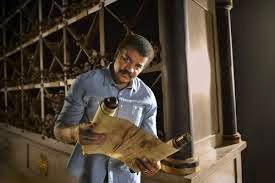
We start in Alexandria, which supported the most impressive library between about 200 BCE and 391 CE.  The Library at Alexandria was a vast academic resource, famous for raiding ships and other lands for... books.  Which would be copied, and the copies stored in Alexandria.  Supported by the royal family, the Ptolemaic Dynasty of Egypt, the Library at Alexandria supported ancient academics for centuries.

Library fines were in ears of corn

Notable faculty included:  Euclid, enemy of 10th grade geometry students everywhere; Archimedes, all-around best scientist and engineer: Eratosthenes, who first calculated the circumference of the Earth and the tilt of the Earth's axis; the mathematicians Theon and his daughter, Hypatia; and Aristarchus, who proposed that the Sun was at the center of the known universe, with the Earth orbiting it.

So what happened?  Well, we know it was destroyed, in various phases, from multiple wars and conquests, starting in about 48 BCE by Julius Caesar invading.  In about 270 CE, Emperor Aurelian invaded, destroying more and taking some scrolls for himself in Constantinople.  Emperor Theodosius, in 390 CE, may have ordered what little remained destroyed when Christianity became the only legal religion of Rome.  And, ibn al Aas may have finished the job in about 642 CE.  Different parties blame each other, making it extremely difficult to know who did what.  What we do know, is that vast troves of ancient knowledge were lost, and Europe entered the Dark Ages.  Tyson's point is that knowledge can only be preserved if we make an effort to preserve it.

So, what happens when knowledge is preserved for future generations?  Tyson then takes for a hot air balloon ride.  With a man named Victor Hess, in 1912.  At the time, radioactive energy had been discovered, usually emanating from sources such as uranium.  Since these were all rocks on Earth, the theory at the time was that radioactive energy came from the Earth.  So, Hess tested that theory by measuring levels of radioactive energy at different levels in the atmosphere, in a hot air balloon.  


Also discovered the Fifth Dimension singing that balloon song

If radiation was coming from the Earth, the radiation levels would decrease with height.  And they did, until about half a mile up.  After that, the radiation levels rose dramatically, the opposite of what was expected. And Hess measured as far up as about 3 miles, which is about half the elevation of a cruising jet plane. Was radiation coming from our Sun?  It seemed a likely culprit, so Hess conducted his radiation measurements, still in a balloon, during a solar eclipse.  And at night.  Still, a constant stream of radiation.  Earth was awash in cosmic radiation all the time.  But where did it come from?

Stars blowing up.  In the 1930s, Fritz Zwicky, working with his partner, Walter Baade, spent years finding supernova explosions, which is where a star with no fuel reserves has finally collapsed under its weight, and the resulting bounce back out is a giant explosion (remember this episode?).  Zwicky and Baade coined the term supernova, and proposed that supernova explosions were propelling the subatomic particles that made up radioactive energy into space, and called them a source of cosmic rays.  Other scientists made their own proposals, or hypotheses, about where the cosmic rays were coming from.   It took until 2013, for another team of scientists to confirm this, using the Fermi Gamma-ray Space Telescope.  It's name is pretty much what it does, it examines gamma rays throughout the universe.  We can document bursts of gamma ray energy with it, and even search for one of our universe's great mysteries.

Sometimes, you're even more right than you know

Wait, our universe is still mysterious?  Even more than you can know at this time.  Mass exerts a gravitational field on other masses (remember this episode?).  The closer objects are, and the more massive they are, the more gravity exists between them.  Let's look at our own Solar System for a second.  Mercury, closest to the Sun, orbits the Sun at about 42,000 miles per hour.   Neptune, way out from the Sun, orbits at about 4,900 miles per hour.  So... why doesn't our galaxy, or any other galaxy behave this way?  At the center of our galaxy, as well as most spirals, is a massive black hole (remember this episode?), with a gravitational pull on the stars and gasses of the galaxy, similar to our Sun working on the planets of our Solar System.  By applying the theory of gravity, shouldn't stars near the edges of galaxies be moving more slowly than stars near the center?

That's what Vera Rubin thought.  A pioneer for women in science, she was the first woman allowed to use astronomical instruments the Palomar Observatory in the mid 1960s.  Literally, women were banned from using a space observatory until the 1960s.

To be fair, we leave our girl cooties everywhere.

Rubin spent her early career making galaxy rotation curves, which is a kind of graph.  She started with the Andromeda Galaxy, one of our nearest neighbors.  For her graph, one side has the speed of the star as it orbits around the center of the galaxy.  One side has the star's distance from the galaxy's center.  Rubin, like everybody else, expected a curve showing that speed decreased with distance.  She got a huge surprise;  star speeds stayed pretty constant despite distance from the galaxy's center.  The"A" curve is what she expected.  The "B" curve is what she got.

Call the cops, the Andromeda Galaxy's breaking the law of gravity!

But that's not all Rubin realized.  Stars were orbiting around the galaxy's center so fast, they should have been breaking their orbits and breaking up the galaxy.  But they weren't, and there was no indication they would.  So, where was the gravity necessary to keep a galaxy together?  Rubin repeated her observations for multiple galaxies, with the same results.  We live in a universe of law-breaking galaxies.  Rubin's math indicated that the Andromeda Galaxy's stars needed about 10 times more mass than they currently had in order to stay together.  She stumped everyone.  In order to solve the mystery that she uncovered, scientists had to go back to Zwicky.

Back in the 1930s, Zwicky was studying the Coma Cluster of Galaxies, which is like a mall, but at the scale of galaxies are bunched together.  He went about calculating the mass of the Coma Cluster based on it's gravitational field, and noticed that it was about, oh... 400 fucking times more massive than the detectable stars of the galaxies (based on the luminosity of the galaxies overall) would indicate.  In other words, the stars of the galaxies in the Coma Cluster were only a paltry amount of the matter necessary to generate the gravity required to hold the Cluster together.  He called it Dunkle Materie.  Which does not translate to Dunkin Donuts, but to Dark Matter. Dark matter isn't necessarily black, or even charcoal gray.  It's called dark because it's almost completely undetectable, except for the effect is has on gravity.  And the effect that gravity has on light, called gravitational lensing.  As predicted by Einstein, if a cluster of galaxies is between me and a more distant background galaxy, dark matter will produce enough gravity to distort the light traveling from the distant background galaxy to me, distorting the image too.  Zwicky predicted that Einstein's gravitational lensing was caused by dark matter, and we confirmed it does happen in 1979.   

Dark matter is estimated to make up about 85% of all matter in the known universe.  And we can barely even detect it.  We don't know what particles it's made of.  We can't even confirm it's made of a sub-atomic particle yet.  But see the pattern- someone's way-out-there data has to be found, usually while answering some other question.  The data that surprises and puzzles scientists then gets several proposed explanations, before one emerges, based on decades of collecting data and improved methods of collecting data that supports one explanation (hypothesis) better than any other.  Over time, and repeated testing, that hypothesis graduates into theory.  Like gravity.  Or germs spreading diseases.  Or evolution by natural selection.  Or relativity.  These were all mysteries, with first philosophers, then naturalists, then scientists, trying to just figure out the mystery to be solved in the first place, and then solving it, based on the preservation of knowledge.  

In the 1920s, Edwin Hubble (yes, the telescope is named after him) got his hands on the biggest telescope of the time, the Hooker Telescope at Mount Wilson, California.  And he wanted to test the theory of the time, that the Milky Way, our galaxy, was the only galaxy.  And that all the universe was contained in our galaxy.  Hubble shocked the astronomy world by insisting that he had used supernova explosions' constant brightness to accurately measure the distance to the nebula containing it, and that the nebula was too far away to be in the Milky Way Galaxy.  But, how do supernovae tell us how far away stuff is?

Once again, we go back Zwicky's partner Walter Baade.  Usually, when a star goes supernova, it's one star, and after the explosion of gas that becomes a surrounding nebula, the star shrinks into a neutron star.  These stars, too small to become black holes and too big to become white dwarfs, can and do spin.  Rapidly.  As they rotate, they emit electromagnetic radiation that varies, like a rotating light on a cop car.  The radiation, and resulting light, reaches us as a pulse.  So, we call some neutron stars pulsars. 

But stars can go supernova in pairs.  When a dwarf star and a giant, paired by gravity, start to die, the dwarf starts absorbing gasses from the giant, literally sucking them away.  When the gasses add too much weight for the dwarf star's core to handle, the dwarf literally collapses in on itself and explodes, causing a supernova with a constant, known light output.  We call these 1a Supernovae, but Baade called them standard candles.   Since we know their brightness, and that the light output is constant, we can find and distinguish them easily.  And, knowing the relationship between apparent and actual brightness, based on distance, we can calculate the distance from Earth to all of the universe's type 1a Supernovae.

Hubble identified some 1a Supernovae, and a few Cepheid variable stars, just hanging out in various nebulae of gasses, and calculated their distances from Earth.  Since other scientists had already estimated the size of the Milky Way Galaxy, Hubble could show that the immense distances to these objects, now more clearly seen in his newer telescope, were too far away to be a part of the Milky Way Galaxy.  Our universe got millions of times bigger immediately.  

And Hubble wasn't done.  Working at about the same time as Georges Lemaitre, the two men discovered, during the late 1920s, that the universe's known matter is actually moving away from each other.  Hubble worked with two previous discoveries:  that of the varying luminosity of Cepheid Variable stars, and the red shift.  Short story, the red shift is the Doppler Effect: the transition from high frequency waves to low frequency waves, depending on whether something is moving towards you or away from you.   We usually apply this to sound, especially sirens or train whistles, but it works with light as well.  Basically, objects in space moving away from you will emit lower-frequency wavelengths of light, appearing red (hence, red-shift).  Hubble plotted the possible locations of other galaxies based on their red-shift appearances, and then plotted these locations over time.  And he discovered that the red-shift was increasing.  And the increase was even more pronounced for galaxies that were already farther away.  In other words, he found that the universe is expanding.  Even though he discovered this after Lemaitre, we still call it Hubble's Law. Basically, the universe is expanding, and the farther away objects are from each other, the faster they move away from each other.

Hubble's Law, together with the Big Bang, suggest a universe that expands, reaches a point where expansion is no longer possible, then starts contracting again due to the gravity of both stars and dark matter in the universe.  But in the 1990s, scientists observed that the rate of expansion had actually been speeding up since Hubble first measured it.  Dark matter was fucked up enough, but now there was something out there, also undetectable, that was fucking with dark matter.  Probably out of sheer laziness, it was called dark energy.  In other words, we determined dark matter must exist because things held together even when we didn't expect them to.  We determined dark energy must exist because the universe is expanding faster than the expected gravity of all that dark matter would let it.

Future generations may discover, based on our current attempts to detect both dark matter and energy, some new relationship between the two, or that they're two aspects of something bigger.  I don't know.  And neither, by his own admission, does Tyson.  What we do know, is that we actually don't know that much about our universe.  We've managed to figure out that there are a lot of other mysteries out there.  Yay for us!  And yay for science!  

So, our universe is much bigger than we originally thought.  How do we get out there, beyond our Sun's reach, maybe even get to the closest stars?  For now, we don't.  Our messengers, Voyager 1 and 2, launched in 1977, do that for us.  They've been traveling at 40,000 mph for about 37 years now, and at least one has already crossed out of our Solar System's fence, into the great interstellar gasses beyond.  How do we know?  The sun releases charged particles, circulating throughout the Solar System as "solar wind".  Solar wind creates a kind of force field around our Solar System, usually way past Pluto, called the heliosphere.  It's immensely useful at repelling cosmic rays from nearby supernovae before those gamma rays can hit Earth and mess up life here.  When there's a lot of cosmic ray activity, it can push against the heliosphere.  Depending on how close and powerful a supernova and it's resulting cosmic radiation are, the heliosphere can actually be pushed in, so that Earth is actually outside of it, exposing us to the cosmic rays.  Notice, I said "can be".  It hasn't actually happened for about 2 million years.

Once again, how do we know?  Little rocks lining huge chunks of ocean floors called manganese nodules.  Hidden in these guys are iron isotopes that would have had to come from a supernova.  Yes, we can estimate the history of supernovae in our cosmic neighborhood from rocks on our ocean floors.  Notice, that throughout the season, Tyson has demonstrate how the very small, even sub-atomic, can create phenomena that can be detected light years away.

Back to Voyager 1. Without the protection of our heliosphere, pressure builds up quite a bit past it from instellar gasses moving around outside our Solar System.  Sometime in 2012, Voyager 1 began sending back info from its plasma wave instrument, indicating that the pressure of insterstellar gasses had gone up.  Which means that Voyager 1 is in the great unknown.  Voyager 2 has yet to catch up.

The spacecraft are expected to send information back for about another ten years. After that, they'll stop collecting information and primarily bear it.  To others.  On both Voyager 1 and 2, is a copy of the Voyager Golden Record.  It contains: a stellar map to Earth using some local 14 pulsars (and their identifying frequencies) that can be triangulated from; greetings in 59 human languages, plus a recording of whales saying whatever they say. The record plays a video as well as audio, and we've included graphic instructions for playing it. 

Like Ikea's instructions, it helps to be a genius to get it right the first time.

At the bottom, on the right, are representations of a hydrogen atom, showing the two states of its lone electron switching rotation.  The time interval of this switch is considered the default measure of time for the information presented on the record and how to play the record.  

Voyager 1 gave us one more present:  a view of ourselves, as we look, from Neptune.  In 1990, Carl Sagan convinced NASA to turn the craft's camera around, for one last photo of ourselves.

We hate the way our hair looks in this picture

We are, literally, a Pale Blue Dot.  Sagan, in his 1994 book called Pale Blue Dot, reminded us that our entire history as a planet and species, takes place on what is, essentially, a speck of dust and water in a universe that can't even make us out from outside the Solar System.  Any importance we assign to ourselves is self-assigned.  And the vast interstellar oceans between us and any other intelligent life renders us, essentially, alone.  No one is coming to save humanity from itself.  Sagan:  "The Earth is where we make our stand."  If we want to live here until the Sun goes out, we will have to figure out some way for all of us to live here responsibly.  Or we will perish together.  

Tyson's getting into his end game here.  He reminds us of the rules of science he first taught us in the premiere:
1- Question authority:  remember Nullius in verba?
2- Question yourself:  what are you assuming?  In other words, make sure you know how you came to know what you think you know.  
3- Don't accept something as true because it's what you want to think.  
4- Test ideas with observation and experiment.  Follow the evidence.  It might confuse you for a while, but whatever happens usually leaves a mark that can be found.  Reserve judgement until you've got some evidence.
5- Remember, you could be wrong.  Especially if you skipped any of the steps above.

Is science perfect?  No, and Tyson admits this.  Scientists developed the nuclear bomb.  Scientists told us lead in the air was safe.  Which is why you always go back to the rules above.  Is the science telling us what we want to hear, based on assumptions?  You could be wrong, and need to go back for more observations, then.  Science also has one advantage in the battle to help humanity- it's not owned by anyone.  No one's got a patent on the scientific method.  We can all use it.  When we support science together, it's owned collectively, making scientists accountable to us collectively.  Making science accountable, both to stick to observable truth, and work for the benefit of those supporting it, is the best we've got.  But that best has gotten us out of the Solar System.  That best has produced electrical power and agriculture, enabling our populations to explode.  That best has enabled knowledge to live forever, as long as we're willing to preserve it.

Now, go discover something.

Tyson ends with what we don't know:  what happened (or what existed) before the Big Bang?  Is anything beyond our cosmic horizon?  How did life begin on Earth?  Or any other living planet?  Tyson, standing on the beach he started the season on, reminds us that science, like life is a chain that connects generations.  He stays on the beach while Imagination, powered by science and wonder, fades back into space, drifting through the stars.

Second star to the right, then straight on til morning...